
5 Common AP Bottlenecks and How to Fix Them
Accounts payable (AP) inefficiencies can cost businesses time, money, and supplier trust. Common bottlenecks include slow invoice approvals, manual data entry errors, poor supplier communication, lack of ERP integration, and risks tied to fraud or late payments. These challenges lead to higher processing costs, missed early-payment discounts, and strained vendor relationships.
Here’s how to address these issues:
- Slow Invoice Approvals: Use automated workflows to route invoices, enable mobile approvals, and escalate overdue tasks.
- Manual Data Entry Errors: Implement AI-powered invoice digitization for accurate data capture and error reduction.
- Poor Supplier Communication: Provide a self-service portal for real-time invoice tracking and profile updates.
- ERP Integration Issues: Ensure direct integration with Oracle ERP systems to eliminate duplicate efforts and improve visibility.
- Fraud and Late Payment Risks: Leverage AI for fraud detection, enforce payment controls, and prioritize early-payment discounts.
Automation tools like AP Express can cut processing costs by up to 81%, reduce errors, and transform AP into a streamlined, efficient process.
Bottleneck 1: Slow Invoice Approvals
Why Approvals Get Delayed
Invoice approvals often grind to a halt when key decision-makers are unavailable or swamped with other responsibilities. Traditional paper invoices, sent through interoffice mail, are especially prone to being misplaced or deprioritized in favor of more urgent tasks. Without a digital system to monitor an invoice’s journey, accounts payable (AP) teams can lose hours trying to track down stakeholders across various departments.
Another major culprit? Manual processes like three-way matching and resolving exceptions, such as incorrect data or missing tax IDs. These steps can stretch approval times significantly. It’s no surprise that 60% of finance leaders cite slow invoice and payment approvals as their biggest challenge.
The financial impact of manual processing is staggering. On average, it costs $15.96 per invoice compared to just $2.94 with automation. Worse, only 4% of smaller businesses manage to pay all purchase order (PO)-based invoices on time, leading to missed early-payment discounts and costly late fees. It’s clear that manual methods are holding organizations back.
Solution: Automated Approval Workflows
This is where AP Express steps in, transforming the approval process with automated workflows. By digitally routing invoices based on predefined hierarchies and dollar thresholds, it ensures instant delivery for review and even allows mobile approvals.
The platform leverages AI-powered matching to cross-check invoices against purchase orders and receiving reports, flagging discrepancies and filtering out exceptions. For low-risk invoices, the system enables touchless processing, while overdue approvals are automatically escalated. This streamlined approach can slash processing times by up to 70%, addressing the delays and errors that plague manual systems.
Bottleneck 2: Manual Data Entry Errors
How Manual Data Entry Hurts Your Business
Relying on manual data entry can be a costly gamble. Research reveals that 88% of manual accounts payable documents contain errors, ranging from incorrect values and dates to mismatched totals. These slip-ups aren’t just inconvenient – they’re time-consuming. On average, each mistake takes about two hours of staff time to fix. Now, imagine an organization handling 10,000 invoices a year with a 5% error rate. That’s a staggering 1,000 staff hours wasted annually just on corrections.
The financial toll doesn’t stop there. Processing an invoice manually costs about $12.88 per invoice, compared to a mere $2.56 with automation. Errors can lead to duplicate payments, which can affect up to 3% of payments even in top-performing industries. They also cause overpayments, underpayments, and inaccuracies in balance sheets. Add to this the fact that 48% of invoices require manual investigation due to exceptions, and it’s clear that accounts payable (AP) teams are spending more time fixing problems than adding value – like capturing early-payment discounts or improving supplier relationships.
“Human error in data entry is one of the most widespread issues found in accounts payable… 88% of manual accounts payable documents include erroneous data-entry occurrences.”
Manual processes also limit scalability. On average, an employee can process only five invoices per hour when entering data manually. These inefficiencies and inaccuracies underscore the necessity of automation to ensure accuracy and enable growth.
Solution: AI-Powered Invoice Digitization
This is where AP Express steps in, transforming the way invoices are handled. Using AI-powered data capture, the platform extracts information directly from PDFs, emails, and scans with an impressive 95% accuracy rate. It automatically reads key invoice details – like vendor names, amounts, dates, and line items – and maps them directly to your Oracle ERP. By eliminating typos, transposition errors, and formatting inconsistencies, the system ensures clean, reliable data.
What sets AP Express apart is its intelligent three-way matching feature, which cross-checks invoices against purchase orders and receiving reports to flag discrepancies instantly. Its machine learning algorithms go a step further by spotting patterns in errors, identifying duplicate invoices, and detecting fraudulent data. For non-PO invoices, automated coding routes them for approval based on preset rules, streamlining the process.
The results? This touchless processing method can slash invoice processing costs by up to 81% and reduce processing times from 15 days to under 5 days. With AP Express, accounts payable shifts from being a cost burden to a strategic advantage.
Bottleneck 3: Poor Supplier Communication
Common Supplier Communication Problems
When suppliers don’t have real-time visibility into invoices, they often end up asking the AP team the dreaded question: “Where is my payment?”. This lack of transparency forces vendors to chase updates, creating headaches for everyone involved. A self-service portal can bridge this gap and streamline communication.
The problem gets worse when communication records are stuck in individual email inboxes. If the AP clerk handling a supplier’s invoice is unavailable, the rest of the team might not have access to the necessary details. This slows down manual exception handling and leaves suppliers in the dark about payment delays, damaging trust. It’s no small issue – 47.3% of AP teams spend six or more hours each week answering vendor inquiries, with 97% of these queries coming in via phone or email. This constant back-and-forth drains resources and risks straining relationships. Suppliers might respond by tightening credit terms, deprioritizing orders, or skipping early payment discounts.
Solution: Supplier Self-Service Portal
Digital platforms offer a way out of these communication challenges. AP Express simplifies the process with a supplier self-service portal that provides vendors with real-time updates on their invoices. From receipt to approval to payment, suppliers can track every step, cutting down on calls and emails to the AP team. This transparency reduces inquiry volume and allows AP staff to focus on more strategic work.
The portal also enables suppliers to manage their own profiles, including banking details, tax IDs, and contact information. Automated validation ensures payments are routed correctly, avoiding errors and delays. By letting suppliers handle updates themselves, the risk of manual data entry mistakes is significantly reduced, helping payments arrive on time.
If there’s a line-item issue or missing information, the portal flags it right away and notifies the supplier. All related communications are stored in one place, eliminating the need to dig through email chains or wait for someone to return from vacation.
“AP Express gives me so many intuitive tools to quickly see where invoices stand and take the right action to keep them moving. This has enabled me to provide more proactive service to our suppliers and become a better business partner.” – Senior Accountant, Mid-Sized Supplier
Additionally, the portal sends automated remittance advice along with expected payment dates, so suppliers know exactly when to expect their funds. This level of clarity can foster trust and often results in better terms and service from vendors. By moving status updates and data management to a self-service model, AP Express turns supplier relationships into opportunities for collaboration rather than sources of frustration.
Bottleneck 4: Poor ERP Integration
ERP Integration Problems
When accounts payable (AP) systems fail to integrate smoothly with Oracle ERP platforms like Oracle E-Business Suite (EBS), ERP Cloud, or JD Edwards, inefficiencies pile up. Manual re-entry becomes unavoidable, consuming both time and money – labor alone accounts for over 60% of the typical AP department’s budget.
Disconnected systems lead to data silos, isolating AP teams from the rest of the organization. Without proper integration, there’s no real-time visibility for internal staff or external vendors. Traditional ERP modules, often not designed to handle document-heavy workflows, lack tools for intelligent data capture, automated routing, and streamlined approval processes. Tasks like manual 3-way matching – reconciling invoices, purchase orders, and receipts – become slow and error-prone, causing payment delays and supplier frustrations.
“Legacy systems exhibit the lowest score for meeting or exceeding business expectations, such as ROI, shortening cycle time and enhancing customer experience.” – The Hackett Group
Integration issues are a major roadblock, delaying 67% of AP automation projects. Small businesses, in particular, can lose up to $12,000 per month on duplicate invoices due to the lack of automated workflows. Repetitive data entry and fragmented approval processes via email further inflate costs, underscoring the urgent need for a more connected and automated solution.
Solution: Direct Integration with Oracle ERP
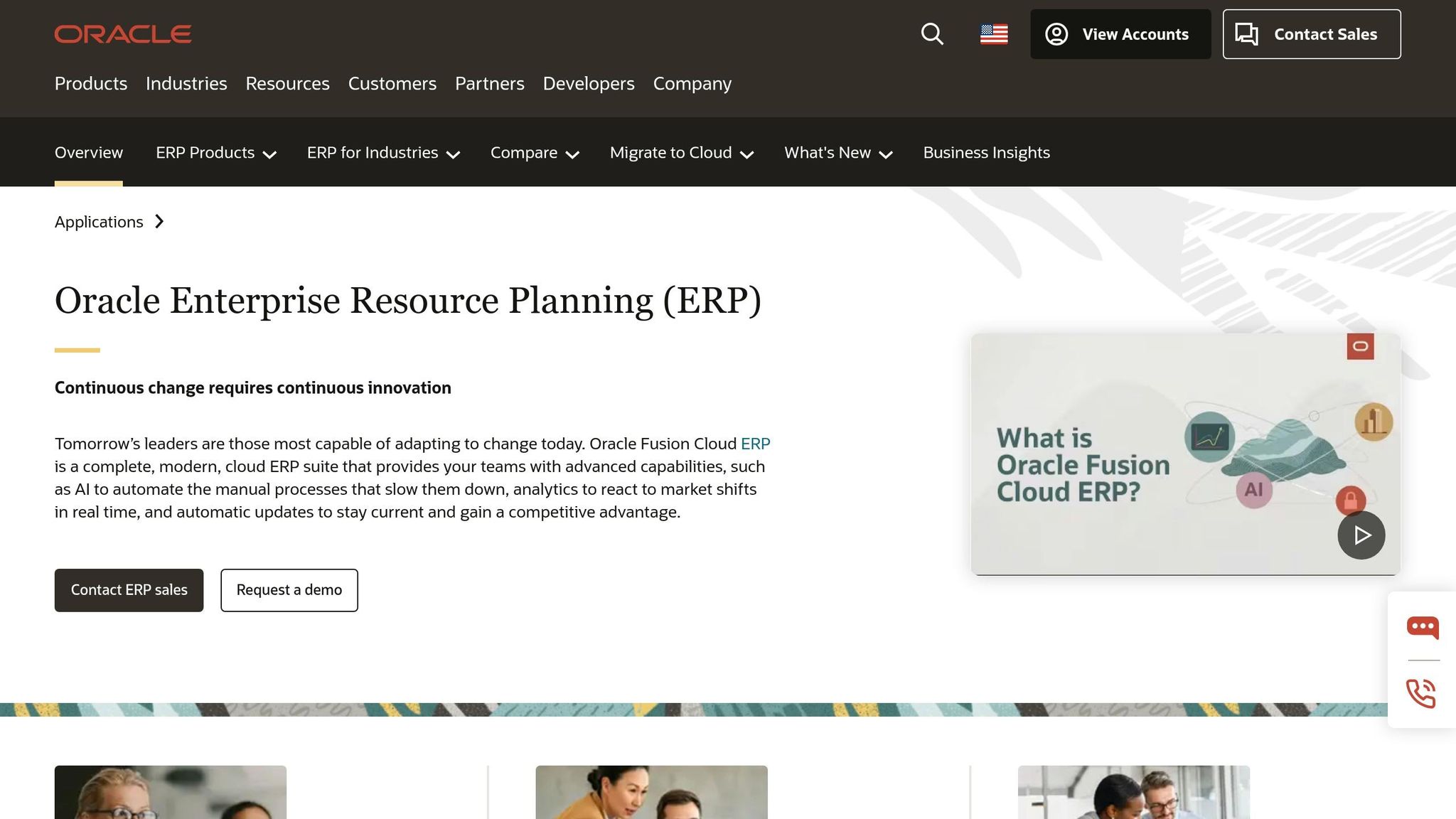
AP Express tackles these challenges head-on by directly integrating with Oracle ERP systems through native adapters tailored for Oracle EBS, ERP Cloud, and JD Edwards. This eliminates the need for manual intervention by automatically posting matched invoices to the ERP. The platform uses AI-powered validation to cross-check invoice data against Oracle vendor master files before sending it to the ERP. Automated 3-way matching compares invoices with purchase orders and receiving documents already stored in your Oracle system, flagging discrepancies immediately to prevent payment delays. With real-time synchronization, businesses gain instant visibility into cash flow and spending patterns as soon as invoices are processed.
“Seamless integration between the AP system and Oracle makes it possible for matched invoices to post to the ERP without anyone having to lift a finger.” – Edenred Pay
Pre-built ERP connectors significantly cut down implementation time – by as much as 60%. This means quicker deployment without the need for custom coding or drawn-out IT projects. AP Express not only preserves your existing controls and approval workflows but also creates a fully digital audit trail from invoice receipt to payment. Its ERP-agnostic design ensures smooth operations even if you transition from Oracle EBS to Oracle ERP Cloud. Automated AP teams can process invoices in less than 25% of the time it takes manual teams, delivering faster processing, improved cash flow visibility, and greater efficiency across the board.
Bottleneck 5: Fraud and Late Payment Risks
Risks of Manual Payment Processes
Relying on manual accounts payable (AP) processes exposes businesses to significant risks, including fraud and late payment penalties. Shockingly, organizations lose about 5% of their annual revenue to fraud, with the average loss per case hovering around $120,000. Even worse, fraudulent activities often go unnoticed for nearly a year, leading to monthly losses between $8,300 and $10,000.
Fraud in manual AP systems often takes the form of schemes involving fake companies submitting bogus invoices, altered check details, or business email compromise. In these cases, fraudsters impersonate executives or vendors to reroute payments. Despite 63% of companies reporting fraud linked to checks, over a third of AP teams (33.3%) still rely on them for more than half of their payments.
“Fraud is the silent killer in accounts payable – do you really know how safe your system is?”
Real-world examples illustrate the damage manual processes can cause. In one case, fraudulent vendors scammed a school system out of $1.4 million, while an office manager embezzled over $150,000 – all enabled by weak AP controls.
Manual workflows also contribute to late payments and missed opportunities for early-payment discounts. On average, manual AP departments capture less than 21% of early-payment discounts. Delays not only strain vendor relationships but also lead to penalties, compounding financial losses. These challenges highlight the urgent need for a solution that addresses both fraud risks and payment inefficiencies.
Solution: Fraud Prevention and Payment Optimization
To tackle these challenges, AP Express integrates advanced fraud prevention tools and payment optimization features. Just as it streamlines approvals and digitizes data, the platform uses cutting-edge controls to safeguard finances and improve payment efficiency.
One key measure is enforcing segregation of duties, ensuring that no single person oversees invoice approval, payment authorization, and bank reconciliation. This reduces the risk of internal fraud. AI-powered anomaly detection flags suspicious activity, such as duplicate invoices, unusually round totals, or sudden spikes in vendor charges.
The platform also employs automated three-way matching, comparing invoices against purchase orders and goods received notes to confirm payments are only made for verified transactions. Real-time monitoring detects unauthorized changes to vendor details like bank accounts or addresses, while secure electronic payment methods (ACH or virtual cards) minimize risks like forgery and mail theft.
On the payment side, AP Express optimizes timing to secure early-payment discounts without jeopardizing cash flow. Automated aging reports help prioritize invoices offering discounts, while virtual card rebates and supply chain finance options provide additional flexibility. A fully digital audit trail ensures every transaction is traceable, making it easier to identify and prevent fraudulent activities before they escalate into major losses.
Conclusion
Managing accounts payable doesn’t have to be a constant drain on resources or a source of ongoing headaches. By automating these processes, businesses can transform AP from a tedious back-office chore into a key player in driving financial efficiency and growth.
Automation brings tangible results. For instance, processing costs can drop by as much as 76% – from $12.88 to $2.56 per invoice – and manual processing times can shrink by up to 80%. With 85% of accounts payable tasks eligible for automation, the potential to eliminate inefficiencies is immense.
Beyond cost savings, automation enhances overall financial strategy. Real-time dashboards offer better insights into spending and cash flow, allowing companies to make proactive, data-driven decisions. Faster payment cycles and self-service portals improve vendor relationships, often leading to more favorable terms and better service. Additionally, integrating directly with Oracle ERP ensures data consistency and eliminates redundant data entry.
“Instead of a data entry role, accounts payable is a partner in accelerating growth, productivity, and profitability.”
The ultimate goal is “touchless” AP, where AI handles tasks like invoice ingestion, matching, and routing, leaving only complex exceptions for human review. This approach allows teams to process higher invoice volumes without adding staff, all while maintaining stronger financial controls. It’s worth noting that companies without proper automated controls and segregation of duties faced a 57% increase in fraud attempts in 2024. By embracing automation, businesses not only safeguard their bottom line but also create a more efficient and secure AP process.
FAQs
How can automation help lower the cost of processing invoices?
Automation takes the hassle out of invoice processing by eliminating tedious tasks such as manual data entry, handling physical paperwork, and correcting errors. This shift can cut labor costs dramatically and reduce the average cost per invoice from $12–$40 to an impressive $1–$2.
Beyond cost savings, automation boosts efficiency. Teams can redirect their efforts toward more strategic tasks, while payments become faster and more accurate – a win-win for businesses aiming to streamline operations.
What are the main advantages of integrating accounts payable with Oracle ERP?
Integrating accounts payable (AP) with Oracle ERP systems simplifies the invoice process by bringing tasks like invoice intake, coding, approvals, and exception handling into one centralized system. This integration creates a smooth, end-to-end workflow that helps speed up processing times and improves cash flow management.
Beyond efficiency, this setup reduces manual errors, ensures more accurate data, and offers clearer insights into financial operations. By automating repetitive tasks and streamlining processes, businesses can save time, cut costs, and redirect their efforts toward higher-value priorities.
How does AI help prevent fraud in accounts payable processes?
AI-powered accounts payable tools are transforming how businesses tackle fraud, stopping issues before payments are even processed. By leveraging technologies like optical character recognition (OCR) and natural language processing (NLP), these systems extract key details from invoices and cross-check them against purchase orders, contracts, and vendor histories. If something doesn’t add up – like mismatched amounts, incorrect vendor names, or altered line items – the system raises a red flag, ensuring potential problems like duplicate or falsified invoices are caught early.
On top of that, AI keeps an eye on spending patterns, spotting anything out of the ordinary. Whether it’s unusually large payments, unfamiliar suppliers, or odd payment terms, the system sends real-time alerts to the accounts payable team, enabling quick responses. It doesn’t stop there – AI-powered analytics also create a detailed audit trail and assign risk scores, making compliance easier to enforce. These systems can even uncover warning signs, such as vendors sharing bank accounts or sudden spikes in invoice activity. By automating these tasks, businesses save time and significantly reduce their exposure to fraudulent transactions.
Related Articles
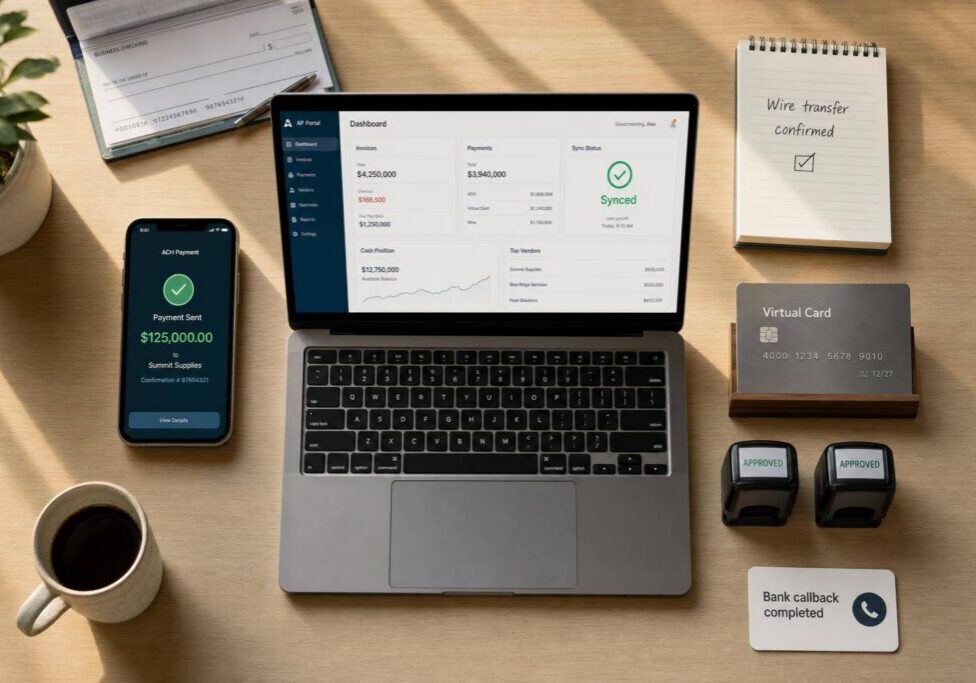
Stop Writing Paper Checks: Faster, Safer, Lower-Cost Payment Options for AP Teams
July 8, 2026 If I run AP, paper checks are the first thing I would...
How AP Automation Solutions Work
December 28, 2021 AP automation solutions are integrated with your ERP system. Data from dozens...