AP Automation vs Manual Processing: Cost Comparison
When it comes to processing invoices, AP Automation is far more cost-effective and efficient than manual methods. Here’s what you need to know:
- Cost per Invoice: Manual processing costs $10–$15 per invoice (up to $40 with hidden costs). Automation reduces this to just $1.45–$3.12.
- Processing Time: Manual workflows take 10–14.6 days per invoice. Automated systems cut this down to 3.1–3.7 days.
- Error Rates: Manual processes have error rates as high as 18%–40%, while automation reduces errors to less than 0.5%.
- Fraud Risk: Automation reduces fraud exposure by 37%, thanks to built-in controls like AI-powered anomaly detection and digital audit trails.
- Efficiency: Automated systems enable one employee to handle 18,649 invoices annually, compared to just 8,689 in manual setups.
- ROI: Companies typically recover their automation investment in 6–12 months, saving up to 70–80% on processing costs.
For businesses using Oracle ERP systems, automation integrates seamlessly to further streamline workflows, reduce errors, and improve financial oversight. If you’re still relying on manual processes, the numbers make a strong case for switching to automation.
Manual vs Automated AP Processing – A Cost Comparison
What Manual AP Processing Actually Costs
The costs of manual AP (Accounts Payable) processing go beyond the obvious. While the direct expense of processing a single invoice ranges from $10.18 to over $13.00, earlier estimates of $15.00 to $40.00 included hidden costs like rework, fraud losses, and wasted time. These additional factors make manual processing far more expensive than it seems at first glance.
Labor Requirements and Time Spent
Manual AP processing demands a lot of time and effort. Tasks like opening mail, printing and scanning invoices, entering data into Oracle ERP, matching invoices to purchase orders, coding non-PO invoices, and chasing approvals all fall on AP staff. On average, a full-time employee in a manual AP department processes just 2.92 invoices per hour, or between 6,082 and 8,689 invoices annually. Compare that to automated systems, where a single employee can handle 18,649 to 23,333 invoices per year. This stark difference highlights how manual methods slow down operations and add to hidden costs.
On top of everything, manual processes take an average of 21 days to complete a single invoice, creating significant delays. Supplier inquiries also eat up time, with AP staff in manual settings spending around 29% of their time answering payment status questions – nearly double the 15% seen in automated environments. Even routine tasks like cutting checks add to the burden, costing $4 to $12 per check when you factor in obtaining signatures, stuffing envelopes, applying postage, and generating positive pay files.
Error Rates and Rework Expenses
Manual data entry is prone to mistakes, with errors occurring in 18% of processed receipts. The overall invoice error rate for manual processing stands at about 2%, meaning that for every 1,000 invoices, roughly 20 need investigation and correction. This adds up quickly, considering that 68% of businesses report errors in more than 1% of their invoices. Fixing each error takes about an hour of AP labor, leading to late payment penalties, missed early-payment discounts, and even compliance issues that can result in audits or fines. On top of that, strained supplier relationships due to errors can lead vendors to increase pricing.
“Manual data entry errors occur in 18% of processed receipts, creating cascading problems that damage vendor relationships, compromise compliance records, and disrupt cash flow management across the organization.”
Delays only make things worse. Around 32% of manual invoices take six days or more to process, and 10% linger for over 21 days. The longer these delays persist, the greater the risk of operational disruptions and financial losses. Manual processes also expose businesses to increased fraud risks.
Fraud Exposure and Financial Losses
Errors in manual systems don’t just waste time – they also open the door to fraud. Globally, fraud costs businesses an average of 5% of their revenue each year. Manual AP systems, which rely heavily on human oversight, lack the consistency needed to monitor large transaction volumes effectively. This creates gaps that fraudsters can exploit.
Fraud attempts have surged in recent years, with 80% of organizations targeted by payments fraud in 2023, up from 65% in 2022. Manual workflows are particularly vulnerable to sophisticated schemes like vendor impersonation, where fraudsters use tactics such as spoofed email domains or deepfake audio to request banking changes. Paper checks are especially risky, with 63% of organizations reporting check-related fraud in 2024, making it the most targeted payment method.
“Manual processes limit real-time oversight… fraud… costs global businesses an average of 5% of their revenue each year.”
– Association of Certified Fraud Examiners (ACFE)
Recovering from fraud is often difficult. Nearly 40% of organizations that suffer losses recover less than 10% of the stolen funds. Manual systems also lack safeguards like enforced separation of duties, increasing the risk that a single employee could both submit and approve fraudulent invoices without detection. Wire transfer fraud has also become a growing concern, with 63% of organizations reporting fraud attempts involving wire transfers in 2024 – up from 39% the previous year. Advanced schemes like deepfake technology make manual verification methods increasingly inadequate.
How AP Automation Reduces Costs
Automating accounts payable (AP) processes reshapes cost management by cutting out the need for constant manual work. With labor making up more than 60% of the average AP budget, getting rid of tasks like manual data entry and rekeying into Oracle ERP systems can lead to immediate savings. Automation takes over by using AI-driven optical character recognition to pull invoice data and post matched invoices directly into Oracle ERP, minimizing errors caused by manual input. Let’s dive into some specific areas where automation delivers measurable benefits.
Lower Cost Per Invoice
Processing invoices manually can cost between $10.00 and $13.54 per invoice – or even as much as $15 to $40 when rework is needed. By contrast, automation reduces those costs to just $1.45 to $2.36 per invoice. That’s a game-changer. Highly automated AP departments report invoice processing costs that are 78% lower compared to manual processes. As the Institute of Finance & Management puts it, “It costs AP departments with no automation and inconsistent processes four times as much to process an invoice as departments with end-to-end automation”.
Paper checks are another area where costs add up. Processing a paper check costs $2 to $4, while ACH transactions range from just $0.26 to $0.50. Take Haviland Enterprises, for example. After implementing automation, they slashed their weekly check run time from over 4 hours to under 20 minutes. This shift freed up 52 AP staff hours each month and brought in $44,000 in rebates during the first year alone. A company representative shared, “Now it takes us five minutes at most [to run checks]”.
Beyond cutting costs, automation drives efficiency across the board.
Faster Processing and Scalability
Automation doesn’t just save money – it saves time. Manual invoice processing typically takes 14 to 17 days, but automation can shrink that timeline to just 2 or 3 days. On average, manual departments need 17.4 days to process an invoice, while highly automated ones finish the job in just 3.1 days. Automated systems also handle three-way matching instantly, validating invoices against Oracle ERP purchase orders and receiving documents. If any information is missing, the system contacts suppliers automatically, sparing AP staff from chasing down details.
Scalability is another standout benefit. Automated departments process around 18,649 invoices per full-time employee annually, compared to only 8,689 invoices in manual setups. This efficiency lets companies handle higher invoice volumes during growth periods without hiring additional staff. For instance, Carrot-Top Industries, a retailer in North Carolina now called Freedom and Glory, used automation to support booming e-commerce growth. They cut AP labor costs by 50% without increasing their team, even as order volumes surged. Similarly, Store Display Fixtures streamlined its workflow, reducing a task that used to take 20 to 30 minutes for five vendors down to just 2 to 3 minutes. This change allowed them to manage payments for dozens of vendors from a single dashboard.
Fraud Prevention and Compliance Controls
Manual processes leave companies vulnerable to errors and fraud, but automation bolsters security and compliance. AI-powered anomaly detection flags unusual patterns, such as invoices from unfamiliar vendors or suspicious amounts just below approval thresholds. Automated three-way matching ensures payments are made only for goods that were actually received. Plus, digital audit trails log every action with time stamps and user IDs, creating tamper-proof records that meet regulatory standards. Automation also enforces separation of duties, so the same person can’t submit, approve, and pay an invoice.
Automation reduces fraud exposure by an estimated 37%. That’s especially important today, as 79% of U.S. organizations faced payment fraud attempts in 2024, with 63% targeted by Business Email Compromise schemes. Greg Bartels from Edenred Pay summed it up well: “Fear of fraud and compliance issues is the top challenge that AP leaders face as their staff works remotely. Without automation, it’s hard to maintain the visibility, tracking, and control AP departments need”. Wyoming Hospitals saw this firsthand, reclaiming 240 staff hours and earning over $36,000 in rebates by switching from manual check printing to a secure, automated workflow.
Side-by-Side Cost Comparison: Manual vs Automated AP
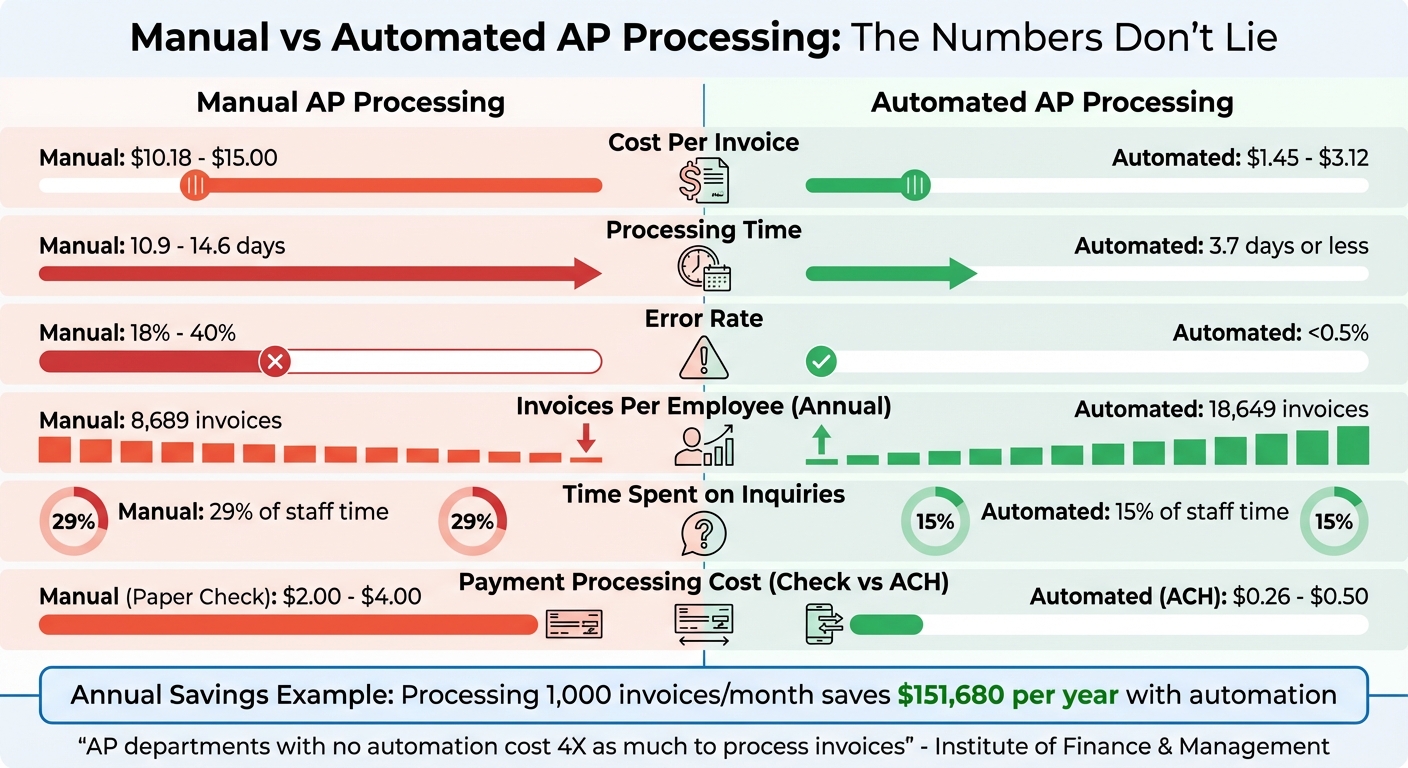
When it comes to accounts payable (AP), sticking to manual processes can be a costly choice. Let’s break it down: manual processing costs range from $10.18 to $15.00 per invoice, while automation slashes that to just $1.45 to $3.12 – a savings of 70–80%. And it’s not just about the money. Processing times drop dramatically too, from an average of 14.6 days to 3.7 days or less. Plus, automated systems drastically reduce error rates, cutting them from as high as 40% to less than 0.5%.
Automation also boosts efficiency. Automated AP departments handle 18,649 invoices per full-time employee (FTE) annually, compared to just 8,689 invoices in manual setups. And while manual teams spend a whopping 29% of their time responding to inquiries, automation reduces that workload to just 15%.
Key Metrics Comparison Table
Here’s a side-by-side look at how manual and automated AP stack up:
| Metric | Manual AP Processing | Automated AP Processing |
|---|---|---|
| Average Cost per Invoice | $10.18 – $15.00 | $1.45 – $3.12 |
| Processing Cycle Time | 10.9 – 14.6 days | 3.7 days or less |
| Invoice Error Rate | 18% – 40% | < 0.5% |
| Invoices per FTE (Annual) | 8,689 | 18,649 |
| Time on Inquiries | 29% of staff time | 15% of staff time |
| Payment Processing (Paper Check) | $2.00 – $4.00 | $0.26 – $0.50 (ACH) |
To put this into perspective, a company processing 1,000 invoices per month would spend about $15,000 monthly (or $180,000 annually) using manual methods. With automation, that cost drops to just $2,360 monthly (or $28,320 annually), resulting in an annual savings of approximately $151,680.
“It costs AP departments with no automation and inconsistent processes four times as much to process an invoice as departments with end-to-end automation.”
– Institute of Finance & Management
Calculating ROI for AP Automation with Oracle ERP
ROI Formula and Sample Calculation
To calculate the ROI for AP automation, use the formula:
ROI = (Annual Savings – Annual Costs) / Annual Costs × 100.
Start by identifying your current manual costs, such as labor, error correction, and material expenses. Then, compare these with the estimated costs of automation, which typically include subscription fees, implementation, and training.
Here’s an example: Imagine your company processes 1,000 invoices monthly at a manual cost of $12.00 per invoice. This adds up to about $144,000 annually. By implementing automation, the cost per invoice might drop to $3.00, reducing annual processing costs to $36,000. That’s a savings of $108,000. Now, let’s say the total investment in automation, including implementation and the first year’s subscription, is $28,000. Using the formula, the ROI would be:
($108,000 – $28,000) / $28,000 × 100 ≈ 285% in the first year.
Many businesses see a full return on their automation investment within 6 to 12 months.
Don’t forget to consider indirect benefits, such as early payment discounts. Automation can also free up about 40% of your AP team’s time, allowing them to focus on strategic tasks. These savings are even more pronounced for companies using Oracle ERP, as detailed below.
Specific Benefits for Oracle ERP Users
For businesses using Oracle ERP, AP automation delivers even greater ROI thanks to seamless system integration. AP Express works effortlessly with Oracle EBS, ERP Cloud, and JD Edwards, enabling real-time data synchronization. This eliminates the need for manual data entry between AP systems and the ERP, creating a single source of truth for financial data. Additionally, the integration provides real-time visibility into cash flow and spending trends through graphical dashboards, even before invoices are posted to Oracle. These features directly contribute to the cost savings highlighted in the ROI calculation, strengthening the case for automation.
Some standout features include AI-powered invoice capture using OCR technology, automated three-way matching (linking invoices, purchase orders, and receipts), and customizable approval workflows tailored to your business rules. Supplier self-service portals further ease the workload by reducing vendor inquiry response times from 29% to 15%. For high-volume Oracle users, bidirectional synchronization ensures vendor records, general ledger codes, and payment statuses stay aligned across systems without requiring manual reconciliation.
Conclusion: The Financial Case for AP Automation
Processing invoices manually costs businesses between $10.00 and $15.00 – or more – per invoice. In contrast, automated systems bring that cost down significantly to just $2.00–$3.12 per invoice. Beyond cost savings, automation speeds up invoice processing times from 10.9–17.4 days to a streamlined 3.1–3.7 days. It also slashes error rates from approximately 18% to less than 0.5% and reduces the risk of fraud – a critical benefit given that 79% of U.S. organizations reported payment fraud in 2024.
The return on investment (ROI) for AP automation is fast and measurable. Most companies recover their investment within six to twelve months. Some, like Granger Construction, have even generated enough in virtual card rebates to completely offset the cost of their automation system. Additionally, AP teams can reclaim up to 40% of their time, allowing them to shift focus from repetitive tasks to more strategic priorities such as negotiating with vendors or optimizing cash flow. These benefits are magnified when automation tools seamlessly integrate with platforms like Oracle ERP.
For businesses using Oracle ERP systems, the advantages are even more pronounced. AP Express integrates effortlessly with Oracle EBS, ERP Cloud, and JD Edwards, eliminating the need for manual data entry while providing real-time visibility into cash flow. Its bidirectional synchronization ensures vendor records, GL codes, and payment statuses are always up-to-date. Furthermore, features like AI-powered invoice capture and automated three-way matching significantly reduce costly errors.
The impact of AP automation goes beyond the accounts payable department. Companies have reported reclaiming up to 240 staff hours and earning tens of thousands of dollars in rebates. With automation reducing costs by 70–80%, cutting cycle times by up to 80%, and embedding strong fraud controls throughout the process, the financial and operational benefits are undeniable.
For Oracle ERP users, AP Express offers the deep integration, advanced AI tools, and proven ROI needed to make the switch to automation both efficient and profitable. These clear advantages highlight why AP automation has become a must-have for modern enterprises looking to stay competitive.
FAQs
How does AP automation reduce errors compared to manual processing?
AP automation takes the headache out of manual data entry by using advanced technology to capture and validate invoice details automatically. This approach significantly reduces errors like typos, duplicate entries, or miscalculations, which are all too common in manual processes.
By standardizing workflows and applying consistent validation rules, automation also flags discrepancies early, helping to avoid costly mistakes and delays. The outcome? A smoother, more dependable accounts payable process that saves time and lowers operational risks.
What are the key advantages of using AP automation with Oracle ERP?
AP automation, when paired with Oracle ERP, tackles the headaches of manual processes head-on. By cutting out repetitive data entry and paper-based workflows, it slashes invoice processing times by about 30%, saving thousands of work hours each year. Beyond saving time, automation enforces business rules, ensuring accuracy and maintaining strong financial controls.
With features like real-time spending insights, improved compliance, and reduced fraud risk, Oracle-based AP automation boosts efficiency and supports growth. Finance teams can process more invoices without needing extra staff, freeing them up to focus on higher-value activities like analytics and supplier negotiations. This seamless system not only trims costs but also fine-tunes accounts payable operations for better performance.
How long does it take for a company to see a return on investment with AP automation?
Most companies see a return on investment (ROI) from accounts payable (AP) automation within six months to a year after rolling it out. Of course, this timeline can shift based on factors like the company’s size, how complex their current processes are, and how quickly teams adapt to the new system.
By cutting down on manual tasks, reducing errors, and simplifying payment workflows, AP automation helps lower costs and boosts efficiency. This combination makes it possible for businesses – no matter their size – to achieve ROI within a reasonable timeframe.
Related Articles

How AP Automation Improves Cash Flow Forecasting
June 3, 2026 Accurate cash flow forecasting is critical for making smart financial decisions, but...
Build trust in your numbers and accelerate the month end close
January 25, 2022 Only 28% of survey respondents said they trust the numbers reported in...