How AP Automation Improves Cash Flow Forecasting
Accurate cash flow forecasting is critical for making smart financial decisions, but manual accounts payable (AP) processes often create errors, delays, and outdated data. Here’s how AP automation solves these problems:
- Eliminates Errors: Automation reduces invoice errors by up to 75% and ensures near-perfect data accuracy.
- Speeds Up Processes: Invoice approval times drop from days to minutes, improving cash flow visibility.
- Provides Real-Time Insights: Automated systems offer up-to-date tracking of liabilities, helping businesses forecast cash flow with precision.
- Optimizes Payments: Early-payment discounts are easier to secure, and payment scheduling becomes more efficient.
- Integrates Seamlessly: Tools sync directly with ERP systems, consolidating data into a single, reliable source.
Businesses using automation report 47% lower operational uncertainty and save up to 70–80% on processing costs. These tools transform AP from a tedious task into a critical asset for financial planning.
Problems with Manual AP Processes for Cash Flow Forecasting
Manual accounts payable (AP) workflows can seriously disrupt accurate cash flow forecasting. They introduce errors, delay approvals, and obscure the timing of cash outflows, making it nearly impossible to create reliable forecasts.
Data Errors from Manual Entry
Relying on manual data entry often leads to duplicate payments, mismatched information across invoices, purchase orders, and receipts, lost invoices, and incorrect ledger coding. Each of these issues distorts cash tracking. For example, duplicate payments – caused by processing the same invoice twice – inflate liabilities and unnecessarily drain cash reserves. Mismatched data can delay payments and throw off ledger accuracy. Additionally, misplaced invoices, whether buried in email threads or lost in piles of paper, often result in unplanned expenses that derail cash flow planning. Misallocated general ledger codes further complicate departmental budgets and spending accuracy.
“Data integrity risks arising from manual data entry can result in duplicate payments or missed invoices, directly leading to unproductive cash expenditures.”
– David Luther, Product Marketing Program Manager, Corpay
These issues have a direct impact on forecasting. One global logistics company saw a 75% drop in invoice errors after adopting AI-powered AP automation, which significantly improved their cash flow management. Automated tools can cut duplicate payments by up to 90% and achieve invoice field extraction accuracy as high as 99.8%. Without automation, these inaccuracies distort cash flow forecasts and create financial blind spots.
Slow Invoice Processing
Manual workflows don’t just create errors – they also slow down the entire invoice process. Traditional paper-based and email-heavy systems often cause invoices to sit idle for days. On average, a manual invoice-to-payment cycle involves about 4.1 human touches and takes roughly 10 days, compared to less than 1 day when automation is used. This delay comes at a cost: 58% of invoices encounter at least one approval delay, and 42% of early-payment discounts are missed due to slow approvals.
“Prior to AP Express, the accounting department didn’t know how many invoices were outstanding or whose desk the invoices were on waiting for approval.”
– Stephanie King, Director, Financial Systems, LCS Family of Companies
When invoices aren’t digitized immediately, finance teams lose visibility into outstanding liabilities. Instead, they’re forced to rely on outdated, static data. This lack of real-time insight means businesses waste an average of 12 working days per financial close. These delays lead to cash flow forecasts based on old data, further reducing their accuracy.
Lack of Real-Time Visibility
Another major drawback of manual AP systems is the absence of real-time tracking, which is essential for proactive cash planning. Manual processes often depend on isolated spreadsheets and paper records, making it nearly impossible to consolidate a complete view of outstanding liabilities. Without real-time updates, teams can’t easily track where invoices are in the approval process or predict when cash will leave the business. This reliance on outdated information undermines forecasting accuracy. In fact, 68% of CFOs report that “bad data” from manual systems negatively affects business efficiency.
Moreover, without up-to-date information, finance teams can’t run “what-if” scenarios to evaluate the impact of delaying payments or taking advantage of early-payment discounts. In 2023, one company eliminated manual data entry and gained real-time AP visibility by partnering with an automation provider. The controller noted that this shift allowed the team to analyze annual spending patterns and secure early-payment discounts, enabling a more proactive and data-driven financial strategy. Without these real-time capabilities, forecasts remain reactive and prone to liquidity miscalculations.
How AP Automation Improves Cash Flow Forecasting
Accurate cash flow forecasting is the backbone of effective financial planning. AP automation takes the guesswork out of forecasting by providing real-time, up-to-date data. Instead of juggling outdated spreadsheets and manually consolidating information, finance teams gain instant access to continuously updated liability data. This eliminates blind spots and allows for precise planning around upcoming cash requirements.
With AI-driven analytics, AP automation can analyze historical payment trends and vendor terms to predict cash flow. This “cash flow intelligence” enables finance teams to simulate various payment scenarios. For example, they can test how delaying a large invoice by a week might impact liquidity goals, helping them make informed decisions about payment timing. Companies using AI for at least half of their AP processes report 47% lower levels of operational uncertainty, particularly in middle-market firms.
Integration with ERP systems further streamlines the process, creating a single source of truth. When AP platforms sync seamlessly with systems like Oracle EBS, ERP Cloud, or JD Edwards, invoices are automatically posted to the general ledger without duplicate entries. This integration can cut manual data consolidation time by up to 75%.
“We needed a solution that was well integrated with EBS because of how critical the ERP is to processing invoices. One of the reasons we chose AP Express is because its integration with EBS is the best in the market.”
– Jean Farmer, Oracle Applications Manager, KCI Technologies
Dashboards also play a key role, flagging potential bottlenecks – like invoices stuck in approval or price mismatches – before they disrupt forecasts. Finance teams can prioritize payments strategically, focusing on critical vendors while optimizing payment terms with others. This approach shifts AP from a time-consuming task to a strategic tool for managing working capital.
Real-Time Invoice Tracking
Automation offers a real-time view of every invoice’s journey, from initial capture to approval and final payment scheduling. This eliminates delays caused by manual processes, providing transparency into the status of every invoice.
Finance teams can monitor which invoices are awaiting approval, which are scheduled for payment, and when cash will leave the business. This level of detail enables accurate 13-week liquidity planning based on actual obligations rather than estimates. Once an invoice enters the system, it’s digitized and instantly matched against purchase orders and receipts, ensuring only validated data is used for forecasting.
Johnny’s Selected Seeds experienced this firsthand in 2025. Under the guidance of Finance Director Michelle Pyle, the company adopted AI-driven data extraction, eliminating manual entry entirely. Pyle shared: “The AI reads and extracts bill data, allowing for easier review. Once approved, it’s all done”. This transformation freed up the finance team to focus on strategic planning using accurate, real-time data.
Automated systems also provide real-time alerts to flag issues like approval delays or mismatched data, preventing errors from escalating into missed payments or inaccurate forecasts. This proactive approach ensures liquidity remains balanced and forecasts stay reliable.
ERP Integration for Centralized Data
Native integration with ERP systems removes the need for manual spreadsheets and fragmented data. When AP platforms sync with tools like Oracle EBS, ERP Cloud, or JD Edwards, vendor and transaction data flow seamlessly between systems without manual input. This creates a centralized financial hub where every invoice, approval, and payment is tracked in one place.
The benefits are immediate. Instead of spending hours consolidating data from different sources, finance teams can access a unified dashboard that reflects current liabilities across all departments. For instance, Old Dutch Foods saw this advantage when CFO Julie Calef implemented AP Express alongside their JD Edwards system. The integration simplified deployment and provided users with visibility into the approval process, something they hadn’t experienced before.
ERP integration also unlocks predictive capabilities. By analyzing historical payment data within the ERP, AI-powered systems can forecast cash positions and recommend payment strategies. For example, they can suggest delaying certain invoices to preserve liquidity or paying others early to secure discounts. This turns AP data into a forward-looking tool for financial planning, with advanced dashboards transforming raw data into actionable insights.
Analytics and Reporting Dashboards
Dynamic dashboards replace static reports, offering actionable insights into cash flow. These tools consolidate ERP and bank data, enabling finance teams to simulate payment scenarios and forecast liquidity.
The shift from static visibility to predictive intelligence is changing how finance teams manage cash. Instead of merely reporting current liabilities, advanced dashboards use analytics to predict payment trends. Finance teams can test scenarios – like delaying a major payment by a week – and instantly see the impact on cash flow and liquidity thresholds.
Cambio Community is a great example. Between 2023 and 2025, the real estate firm expanded from two to 32 communities, with invoice volume jumping from 1,500 to 3,500 bills per month. CFO Sarah Janowicz implemented AP automation to handle the increased workload without adding staff. Real-time analytics gave leadership a clearer view of costs and vendor relationships, helping them make data-driven decisions about payments and supplier management.
Dashboards also support strategic payment prioritization. They rank invoices based on urgency, vendor importance, and operational impact, allowing finance teams to set automated alerts tied to specific liquidity goals. This prevents cash levels from dropping below safe thresholds. By ensuring critical suppliers are paid on time while maintaining flexibility with others, automation achieves a balance that manual processes simply cannot.
Better Cash Flow Management with AP Automation
AP automation transforms accounts payable from a reactive process into an asset that supports strategic financial decisions. By speeding up approval workflows and fine-tuning payment schedules, finance teams can control when cash leaves the business. This approach not only preserves liquidity but also strengthens relationships with vendors.
Automated systems slash invoice processing costs from $12–$30 down to $3–$5, cutting overall expenses by 70–80%. These tools redefine approval processes, help secure early-payment discounts, and reduce costly mistakes.
Faster Approvals and Payment Scheduling
Quick approvals provide finance teams with better cash flow visibility. Manual processes often delay payments and obscure cash flow clarity – 58% of invoices experience approval delays, with each requiring an average of 4.1 manual touches. Automation solves this by routing invoices directly to the right people using workflows and AI-driven three-way matching. This reduces approval times from days to mere minutes, processing 90% of invoices in under 30 seconds with near-perfect accuracy. The result? A shorter invoice-to-payment cycle – dropping from over 8 days to just 1–2 days with automation.
“AP Express provides complete visibility of each invoice and its journey through the AP process.” – Stephanie King, Director of Financial Systems, LCS Family of Companies
Automated payment scheduling takes this efficiency a step further. These systems analyze due dates, available early-payment discounts, and real-time cash flow to determine the best payment timing. This allows companies to strategically delay non-urgent payments to conserve working capital while ensuring critical vendors are paid promptly. Extending Days Payable Outstanding (DPO) without affecting supplier relationships gives businesses more control over their cash flow cycles.
Taking Advantage of Early Payment Discounts
Early-payment discounts can offer significant savings, but manual systems often fail to take advantage of them. In fact, 42% of these discounts are missed due to slow approval times in traditional workflows. Automation changes the game by accelerating processes and highlighting discount opportunities in real time.
For example, when an invoice includes a 2/10 net 30 discount, automated systems prioritize it, notify approvers instantly, and schedule payment within the discount window. This approach increases the discount capture rate from 22% in manual systems to 67% with automation. These savings improve cash flow forecasts and boost liquidity.
Additionally, virtual cards provide another layer of financial flexibility. They delay cash outflows, extend payment float, and even offer cash-back rebates of 0.5% to 2%. By combining faster approvals with strategic payment tools, finance teams can capture discounts when liquidity permits or conserve cash during tighter periods – all while maintaining accurate financial forecasts.
Lower Costs and Fewer Errors
Manual AP processes are prone to errors, including duplicate payments, late fees, and data entry mistakes, all of which can drain resources and skew cash flow forecasts. Automation significantly reduces these issues, achieving error rates as low as 0.03% to 0.2%.
Three-way matching capabilities ensure that payments are only made for validated invoices by comparing them against purchase orders and receipts. This feature reduces invoice errors by 75%, preventing overpayments and improving data accuracy. Businesses leveraging AP automation also save an average of 24 working days each year. By minimizing errors and cutting processing costs, automation turns cash flow management into a proactive, data-driven process that supports better financial decision-making.
How AP Express Improves Forecasting Accuracy

AP Express addresses forecasting challenges by combining AI-driven automation with seamless ERP integration. The platform ensures invoice data is captured accurately, offers real-time insights into payables, and consolidates financial reporting into a single, reliable system. This turns forecasting into a data-driven process rather than a guessing game. Let’s break down how AP Express achieves this.
AI-Powered Invoice Digitization
With AI-powered tools, AP Express ensures 95–100% accuracy for invoices on their first entry. By digitizing the entire process – capturing, cleaning, and preparing invoice data – the platform eliminates manual errors that often distort financial forecasts. This is especially important since 68% of businesses still manually input invoices into their systems, leading to high costs and frequent mistakes. Even better, 90% of invoices are processed in under 30 seconds, ensuring liabilities are promptly recorded.
The platform also automates three-way matching, comparing invoices with Purchase Orders and receipts. This ensures only valid and accurate liabilities are included in financial projections. For mid-sized businesses using AI for at least half of their AP tasks, operational uncertainty drops by 47%.
The Supplier Self-Service Portal takes this efficiency a step further by enabling vendors to directly manage their invoices.
Supplier Self-Service Portal
The Supplier Self-Service Portal eliminates bottlenecks by allowing vendors to submit invoices directly and monitor their status in real time. Vendors can upload invoices in PDF or CSV format, check payment statuses, and update their contact or banking details. This direct input ensures liabilities are immediately visible to finance teams, improving cash flow forecasting.
On average, AP teams spend 35% of their time – about seven days per month – handling supplier inquiries. With the portal, this time can be redirected to strategic planning. The built-in message center archives all communications related to disputes or discrepancies, creating a clear audit trail and resolving issues faster. Additionally, the portal supports supply chain finance options, enabling suppliers to receive early payments through funding partners while giving businesses an extra 30–45 days to settle payments.
“Before…our AP team spent way too much time responding to email and phone inquiries from our suppliers… The AP Express Supplier Portal was a perfect fit.”
– Christopher Gann, AP Manager, Nebraska Furniture Mart
ERP Integration and Reporting Tools
AP Express integrates natively with Oracle EBS, Oracle ERP Cloud, and JD Edwards, ensuring that the ERP remains the single source of truth for financial data. It syncs all master data – like supplier details, purchase orders, and receipts – in real time, eliminating delays from manual entry or disconnected systems. Even better, this integration is completed in just 30 minutes without requiring IT support or customizations.
Finance teams can dive deep into transactions using drill-down features within their Oracle environments, gaining insights into both detailed and aggregate data for better forecasting. For example, AMLI Residential’s AP Manager, Tiffany Thomas, used AP Express to fully automate their AP process. The integration helped them approve invoices faster and make more informed financial decisions.
“AP Express has helped us automate our end-to-end AP process while providing our team with the visibility they need to approve invoices and make better financial decisions.”
– Tiffany Thomas, AP Manager, AMLI Residential
Measuring the Impact of AP Automation on Cash Flow Forecasting
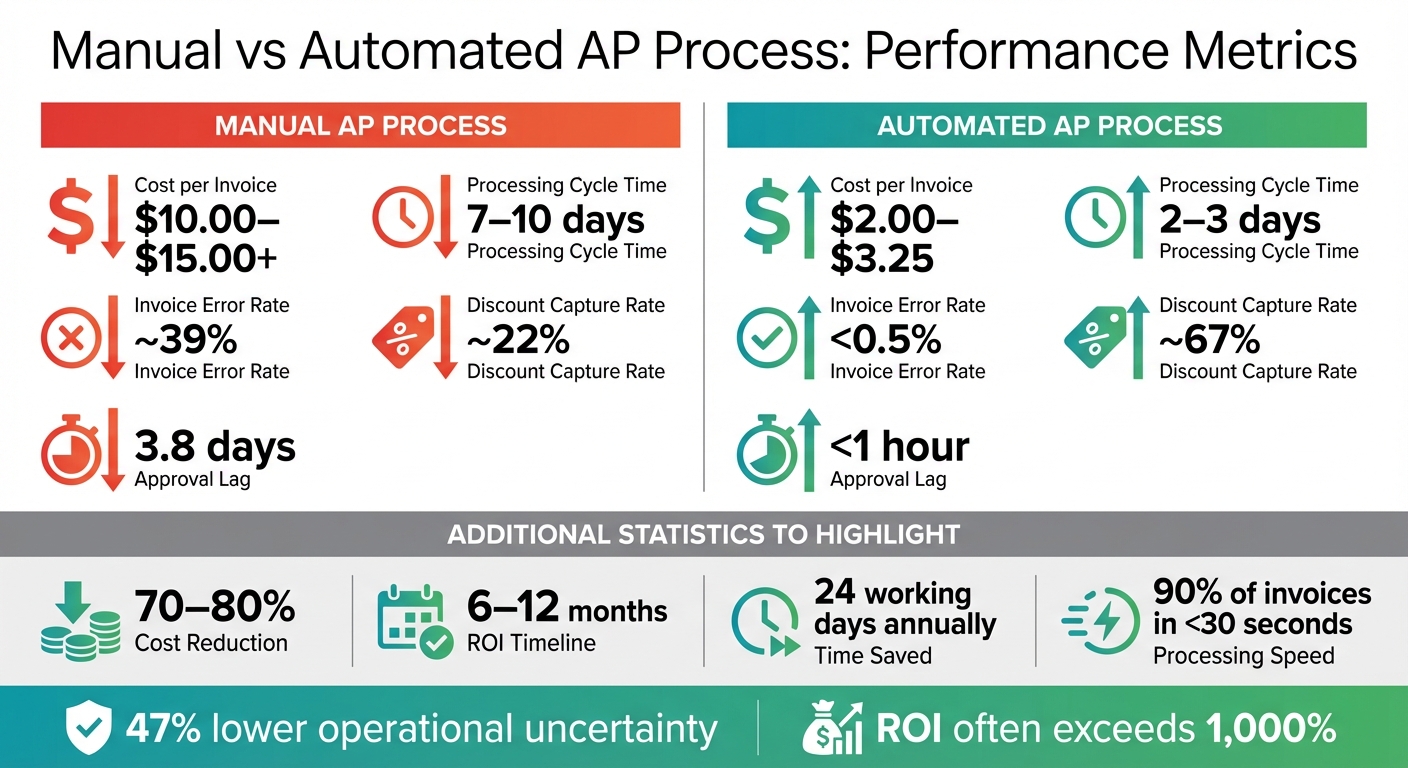
Tracking the right metrics is essential to highlight the benefits of AP automation. The numbers paint a clear picture of the contrast between manual and automated processes – whether it’s processing costs or forecast accuracy. By examining these metrics, finance teams can validate their investment and uncover opportunities for further improvement. Here’s how automation transforms operations.
Key Metrics for Comparison
AP automation delivers impressive cost and time savings. For instance, it slashes invoice processing costs from $10.00–$15.00+ to just $2.00–$3.25 per invoice, a reduction of 70–80%. Processing speed also improves dramatically, with cycle times shrinking from 7–10 days (manual) to just 2–3 days with automation. Here’s a breakdown of key performance metrics:
| Metric | Manual AP Process | Automated AP Process |
|---|---|---|
| Cost per Invoice | $10.00–$15.00+ | $2.00–$3.25 |
| Processing Cycle Time | 7–10 days | 2–3 days |
| Invoice Error Rate | ~39% | <0.5% |
| Discount Capture Rate | ~22% | ~67% |
| Approval Lag | 3.8 days | <1 hour |
Errors are another area where automation shines. Manual processes often see error rates near 39%, but automation reduces this to under 0.5%. With fewer errors, cash flow forecasts become more reliable, as they’re based on accurate, up-to-date data. Automated systems also excel at identifying early payment discounts, boosting capture rates from around 22% to 67%.
Calculating ROI from AP Automation
The financial returns from automation are substantial and measurable. Most organizations achieve full ROI on AP automation within 6–12 months. The formula for calculating ROI is straightforward:
ROI (%) = (Net Annual Savings / Total Initial Investment Cost) × 100%
Savings come from reduced labor costs, fewer errors, captured discounts, and rebates from virtual card payments. For example:
- Haviland Enterprises cut its weekly check run from over 4 hours to under 20 minutes, saving 52 AP hours each month and earning $44,000 in first-year rebates.
- Granger Construction reduced paper checks by 71% and earned enough rebates to cover the cost of their automation solution entirely.
Beyond cost savings, automation gives organizations back time. On average, companies reclaim about 40% of their AP team’s time through full-service automation. For instance, Wyoming Hospitals saved 240 staff hours previously spent on check printing and earned over $36,000 in rebates. This freed up resources to focus on priorities like patient care.
These time savings lead to better cash flow analysis, improved vendor relationships, and stronger financial planning.
“You really don’t have to sell anyone on it. It pays for itself.”
– Granger Construction
Conclusion
Relying on manual accounts payable workflows creates challenges for cash flow forecasting. Issues like data errors, processing delays, and a lack of real-time visibility into cash positions can disrupt financial operations. By tackling these problems, AP automation not only improves forecasting accuracy but also enhances overall efficiency. With tools offering real-time tracking, AI-powered data capture boasting 95–100% accuracy, and seamless ERP integration, finance teams gain the dependable data they need to confidently forecast cash positions.
Platforms such as AP Express bring additional benefits, including virtual card rebates, optimized payment scheduling, and significant time savings – freeing up an average of 24 working days annually. When Old Dutch Foods adopted AP Express, CFO Julie Calef shared:
“Implementing AP Express has been a painless experience. The application matches the JD Edwards user experience and that made rollout and adoption very easy. It gives our users visibility into the approval process that they have never had before”.
This enhanced visibility directly supports smarter cash management decisions. The return on investment (ROI) often exceeds 1,000%, and companies using AI for at least half of their AP processes are 47% less likely to experience high operational uncertainty. These aren’t small gains – they represent a major transformation in finance operations, combining precision with meaningful cost savings.
By replacing outdated spreadsheets with integrated ERP systems and AI-driven tools, businesses can ensure every payment decision is based on reliable data. The outcome? Trustworthy forecasting, optimized cash flow, and a finance team freed up to focus on strategic priorities instead of routine data entry.
For businesses aiming for sustainable growth, achieving financial accuracy and operational efficiency is non-negotiable. AP automation makes both possible. The time to act is now.
FAQs
How does automating accounts payable improve cash flow forecasting?
Automating accounts payable (AP) transforms cash flow forecasting by offering real-time visibility into outstanding payments, simplifying data collection, and reducing manual mistakes. With automation, businesses gain access to up-to-date financial information, making cash flow predictions more accurate and timely.
By replacing manual tasks with automated processes, payment schedules, invoice tracking, and supplier information remain consistently updated. This empowers finance teams to make well-informed decisions and manage cash flow more effectively.
How does AP automation help businesses save money?
Automating accounts payable (AP) is a smart way for businesses to trim costs tied to manual invoice processing. By automating repetitive tasks like data entry, approvals, and payments, companies can cut labor expenses, steer clear of late payment fees, and even benefit from early payment discounts.
On top of that, automation minimizes errors and simplifies workflows, saving time while boosting efficiency. These savings can lead to impressive results – many businesses report ROI rates ranging from 70% to 80%.
How does tracking invoices in real time help with financial planning?
Real-time invoice tracking provides a clear, up-to-the-minute view of your cash outflows, which can greatly improve financial planning. With this level of visibility, you can forecast cash flow more accurately, prioritize payments effectively, and adjust payment schedules as needed to maintain steady liquidity.
Automating this process takes it a step further by minimizing uncertainties, helping you avoid late payment penalties, and supporting smarter financial decisions. The result? Better overall cash management and fewer financial headaches.
Related Articles

The Road to Touchless Processing: Step 3, Define Your Metrics
March 24, 2026 This is the third blog post in a series on touchless processing....
Clean 1099 Reporting Starts Early: Use a Supplier Portal to Validate Vendor TINs
July 9, 2026 1099 problems usually start long before January. If I wait until year-end...