Late Payments in AP: How Alerts Solve the Problem
Late payments hurt businesses more than you think. From damaged supplier relationships to financial penalties, the costs add up fast. The good news? Tools like real-time alerts in Oracle ERP and AP Express can help you stay on top of payment deadlines and avoid these issues.
Here’s the bottom line:
- 41% of late payments are caused by data entry errors and poor visibility.
- Businesses lose 1%–3% of invoice value by missing early payment discounts.
- Overdue invoices can lead to penalties of 1.5% per month.
Oracle ERP’s real-time alerts notify teams about payment deadlines, invoice holds, and other issues before they escalate. When combined with AP Express, which automates invoice processing and approvals, you can reduce errors, save time, and improve supplier relationships – all while cutting costs.
If late payments are a recurring problem, leveraging these tools can transform your accounts payable process. Keep reading to learn how they work and why they’re effective.
How Late Payments Affect Business Operations
Late payments can create a domino effect, leading to financial losses, operational inefficiencies, and strained relationships with suppliers. Let’s break this down further.
Financial Costs of Late Payments
The financial toll of late payments is undeniable. Companies often face late fees and lose out on early-payment discounts, which can quickly add up. For instance, a mid-sized manufacturing company lost $46,000 in early-payment discounts over just three months due to poor visibility caused by a manual accounts payable (AP) process.
Consider this: in May 2025, a major U.S. electronics retailer processing 5,000 invoices monthly incurred $1.075 million in losses due to inefficient AP practices. Here’s the breakdown:
- $500,000 in vendor attrition costs after losing a key supplier
- $150,000 in monthly late fees
- $200,000 in missed early-payment discounts
- $100,000 in regulatory fines for violating payment laws
These financial setbacks often push businesses into short-term borrowing, leading to additional interest costs and further straining budgets. It’s clear that effective payment management is critical to avoid these cascading expenses.
Operational Problems from Late Payments
Late payments are often a symptom of deeper inefficiencies within a company’s operations. Manual workflows and disorganized approval processes can cause invoices to get lost or delayed. This lack of structure leaves finance teams in the dark about outstanding obligations.
“Prior to AP Express, the accounting department didn’t know how many invoices were outstanding or whose desk the invoices were on waiting for approval.”
- Stephanie King, Director, Financial Systems, LCS Family of Companies
Such delays don’t just disrupt day-to-day operations – they also compromise financial planning. Without accurate tracking of pending invoices or overdue payments, companies struggle to forecast cash flow or close their books on time. This lack of visibility can turn period-end reporting into a guessing game, underscoring the importance of tools like real-time alerts in Oracle ERP.
Damaged Supplier Relationships
Late payments can also harm external partnerships. Payment history, which makes up 35% of a company’s credit score, is a key indicator of financial reliability. A reputation for being a “slow payer” can spread quickly, making it harder to attract high-quality suppliers or negotiate favorable terms.
Suppliers who consistently face delayed payments may deprioritize your orders, especially during peak demand or supply shortages. They might also raise prices, demand larger upfront deposits, or even sever ties altogether. For smaller suppliers, prolonged delays could jeopardize their financial health, potentially leading to the loss of a crucial vendor and leaving gaps in your supply chain.
The ripple effects of late payments go far beyond the immediate financial penalties, impacting both internal operations and external relationships in ways that can be difficult to recover from.
How Real-Time Alerts in Oracle ERP Prevent Late Payments
Oracle ERP comes equipped with tools specifically designed to help businesses avoid late payments. Among these, real-time alerts serve as an early warning system, constantly scanning the accounts payable (AP) database and notifying the right people when action is required.
How Oracle Alerts Work in Accounts Payable
Oracle Alert is a flexible monitoring tool that tracks critical AP activities, automatically spotting issues like invoice holds or discrepancies. It notifies relevant team members through periodic updates (e.g., weekly summaries) or immediate alerts triggered by specific events, such as exceeding purchase order limits. Pre-coded alerts are available for common AP issues, including price holds, quantity received holds, and quantity ordered holds.
For Oracle ERP Cloud users, Analytics Publisher enhances this functionality by delivering tailored email and in-app notifications for tasks like Invoice Approval, Hold Resolution, and Payment Approval. These notifications ensure that important payment deadlines are not missed.
Timely Notifications for Payment Deadlines
Real-time alerts play a critical role in keeping payment deadlines on track. For instance, when an invoice needs approval, the system keeps staff informed as the approval process moves forward. If any discrepancies occur – such as when the billed quantity exceeds the received quantity – the system directs alerts to the purchasing agent for quick resolution.
Additionally, the system monitors contracts and purchase agreements, sending reminders before they expire. This prevents delays in invoice processing caused by outdated agreements. On top of that, predictive analytics assign a “Risk Score” to flag potential late payments. These predictive models work best with at least 24 months of historical data and are updated daily.
Better Visibility with AP Express

Building on Oracle ERP’s alert system, AP Express further enhances invoice processing and visibility. Seamlessly integrating with Oracle EBS, ERP Cloud, and JD Edwards, AP Express processes 90% of invoices in under 30 seconds, achieving 95–100% accuracy on the first attempt. Its AI-driven automation provides real-time insights across the entire invoice lifecycle.
“Implementing AP Express has been a painless experience… It gives our users visibility into the approval process that they have never had before.”
- Julie Calef, CFO, Old Dutch Foods
Julie Calef, CFO of Old Dutch Foods, highlighted how AP Express improved visibility into the invoice approval process, enabling faster adoption and smoother supplier management.
Oracle ERP Alert Types for Managing Payment Deadlines
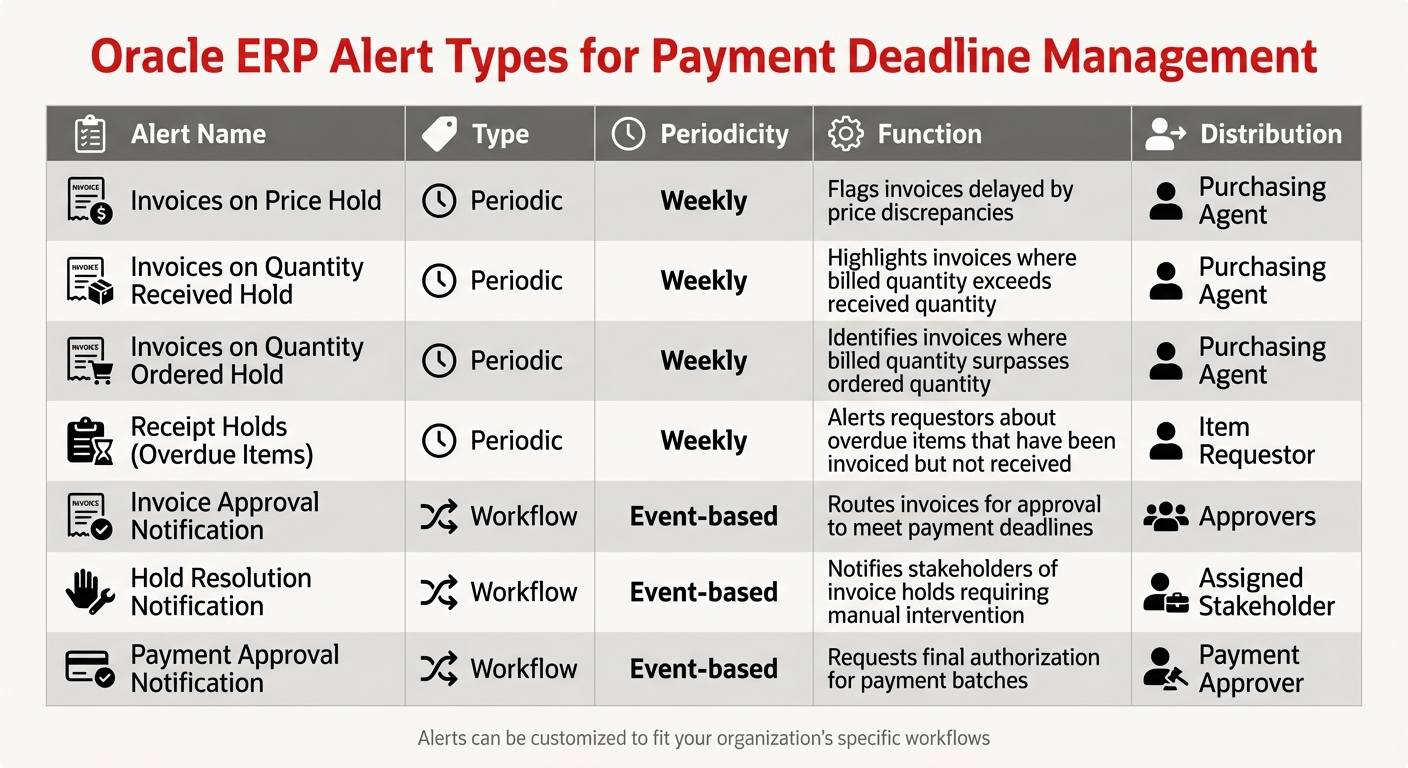
Oracle ERP relies on two main alert types to help manage payment deadlines: Event Alerts and Periodic Alerts. Event Alerts are triggered immediately when specific database events occur, such as when an invoice is entered or updated. Periodic Alerts, on the other hand, operate on a set schedule, allowing businesses to identify and address potential issues before they escalate.
These alerts aren’t limited to just sending emails. They can execute SQL scripts, run operating system commands, or even submit concurrent requests to automate follow-up actions. If an issue, like an unresolved invoice hold, continues unchecked, Action Escalation steps in. This feature raises the urgency level, starting with a notification to a clerk and escalating to a manager if no action is taken.
Comparison of Key Alert Types
Oracle Payables includes pre-configured alerts designed to tackle specific payment process bottlenecks. Each alert serves a unique purpose, ensuring smooth payment workflows:
| Alert Name | Type | Periodicity | Function | Distribution |
|---|---|---|---|---|
| Invoices on Price Hold | Periodic | Weekly | Flags invoices delayed by price discrepancies | Purchasing Agent |
| Invoices on Quantity Received Hold | Periodic | Weekly | Highlights invoices where billed quantity exceeds received quantity | Purchasing Agent |
| Invoices on Quantity Ordered Hold | Periodic | Weekly | Identifies invoices where billed quantity surpasses ordered quantity | Purchasing Agent |
| Receipt Holds (Overdue Items) | Periodic | Weekly | Alerts requestors about overdue items that have been invoiced but not received | Item Requestor |
| Invoice Approval Notification | Workflow | Event-based | Routes invoices for approval to meet payment deadlines | Approvers |
| Hold Resolution Notification | Workflow | Event-based | Notifies stakeholders of invoice holds requiring manual intervention | Assigned Stakeholder |
| Payment Approval Notification | Workflow | Event-based | Requests final authorization for payment batches | Payment Approver |
Alerts can be configured to send either Detail Actions, which deliver a notification for each exception, or Summary Actions, which consolidate multiple exceptions into a single notification. To avoid overwhelming recipients, Summary Thresholds automatically switch to summary notifications when exceptions exceed a predefined number.
These standard alerts can serve as a foundation, but they can also be tailored to better fit your organization’s specific workflows.
Customizing Alerts for Your Business
Oracle Alert offers robust customization options, allowing businesses to fine-tune alerts to align with their unique payment processes. For instance, you can modify the SQL Select statements to pull the exact data you need, adjust how often notifications are sent, and personalize email content using Analytics Publisher templates.
To ensure alerts reach the right individuals, you can configure a flexfield in the HR_EMPLOYEES table to store email addresses. This enables precise routing of notifications, such as directing held invoice alerts to the purchasing agent responsible for the relevant vendor or order.
Additional features, like Prevent Workflow (which halts approvals until issues are resolved) and Prevent Close (which blocks period-end closure until exceptions are cleared), can help enforce compliance. For time-sensitive matters, you can set up automatic priority escalation. This ensures that if an assignee doesn’t act within a certain timeframe, the priority level of the alert will automatically increase from Medium to High.
Using AP Express for On-Time Payments
Setting Up Alerts in Oracle ERP
To ensure smooth operations, Oracle ERP allows you to activate Oracle Business Events through the “AP: Enable Business Events” profile in Oracle Cloud. These events trigger real-time updates, such as “Invoice Hold Applied” or “Payables Payment Created.” Oracle Payables also comes with pre-configured weekly alerts that flag common issues, like price holds or quantity mismatches. These alerts automatically notify purchasing agents, giving them ample time to resolve problems before payment deadlines.
You can further tailor these notifications using Oracle Analytics Publisher. This tool lets you customize email templates with specific invoice details, branding, and direct links to the Worklist for quicker action. When making changes, it’s important to copy data models into a “Custom” folder instead of altering the original notifications. Once alerts are set, AP Express takes over, automating the next steps in the payment process.
Automating AP Processes with AP Express
After configuring alerts, AP Express simplifies the entire accounts payable workflow. The platform integrates seamlessly with Oracle EBS, ERP Cloud, and JD Edwards in under two hours. It processes 90% of invoices in less than 30 seconds and uses AI-powered data capture to achieve 95–100% first-pass accuracy. Its streamlined four-step process – Receive, Digitize, Validate, Approve & Pay – offers full visibility from invoice receipt to payment.
Jean Farmer, Oracle Applications Manager at KCI Technologies, shared:
“One of the reasons we chose AP Express is because its integration with EBS is the best in the market.”
Additionally, the Supplier Portal enhances vendor relationships by allowing suppliers to track their invoice status, significantly reducing inquiries to your AP team. Stephanie King, Director of Financial Systems at LCS Family of Companies, highlighted:
“AP Express provides complete visibility of each invoice and its journey through the AP process.”
Benefits of Combining AP Express and Oracle ERP
When AP Express is paired with Oracle ERP’s alert system, businesses gain the advantage of automated validation and intelligent matching to purchase orders and receipts, minimizing the risk of fraudulent payments. The faster processing speed also enables organizations to capture early-pay discounts and earn virtual card rebates, effectively turning the AP department into a source of profit. Many companies report an ROI exceeding 1,000%.
Beyond the financial gains, the system’s accuracy and efficiency foster stronger supplier relationships by ensuring reliable, on-time payments. This integration doesn’t just reduce late payment risks – it elevates the role of accounts payable into a key strategic driver for your business.
Conclusion
Late payments don’t have to be a constant headache for accounts payable teams. With real-time alerts in Oracle ERP, teams gain the ability to proactively address issues like price holds, quantity mismatches, and receipt delays before they disrupt payment schedules. These alerts ensure purchasing agents are notified immediately, allowing them to fix problems on the spot instead of discovering them long after the fact.
Taking it a step further, integrating Oracle alerts with AP Express eliminates systemic delays by routing issues directly to the right person. This keeps workflows moving smoothly and avoids unnecessary bottlenecks.
The benefits go beyond avoiding late fees. By capturing early-payment discounts and virtual card rebates, businesses are turning their AP departments into revenue contributors. Plus, consistent, on-time payments strengthen supplier relationships, building trust and positioning your company as a preferred partner.
FAQs
How do real-time alerts in Oracle ERP help avoid late payments?
Real-time alerts in Oracle ERP are a game-changer for avoiding late payments. These alerts quickly flag invoices or suppliers that might miss payment deadlines, giving your team the chance to act immediately to prevent delays.
By tackling potential issues early, you can keep supplier relationships strong, dodge late fees, and keep your cash flow running smoothly.
How does using AP Express with Oracle ERP alerts help reduce late payment costs?
Combining AP Express with Oracle ERP alerts can transform your accounts payable processes, delivering noticeable financial benefits. Real-time alerts keep you informed about upcoming payments, while AP Express takes over tasks like invoice processing, approvals, and payment workflows. The result? Fewer delays, reduced errors, and no more expensive late fees.
This integration also boosts efficiency with AI-powered invoice digitization and automated exception handling. By cutting out manual work and improving precision, businesses can better manage their cash flow and see a stronger return on investment (ROI).
How do late payments affect supplier relationships, and how can alerts help prevent them?
Late payments can damage supplier relationships, leading to distrust and interruptions in the delivery of goods or services. When delays happen too often, suppliers might respond by tightening payment terms, limiting flexibility, or even ending agreements altogether.
One way to avoid this is by using real-time alerts. These notifications help your accounts payable team stay on top of upcoming or overdue invoices. By ensuring payments are handled promptly, you can maintain healthy supplier relationships, avoid penalties, and keep operations running smoothly.
Related Articles

Stop Writing Paper Checks: Faster, Safer, Lower-Cost Payment Options for AP Teams
July 8, 2026 If I run AP, paper checks are the first thing I would...
AP Automation and the Total Cost of Ownership
April 16, 2026 API-based IntegrationFile-based IntegrationExplanationIdentifying required data elements within the ERP system$0$API-based integrations are...