Stop Writing Paper Checks: Faster, Safer, Lower-Cost Payment Options for AP Teams
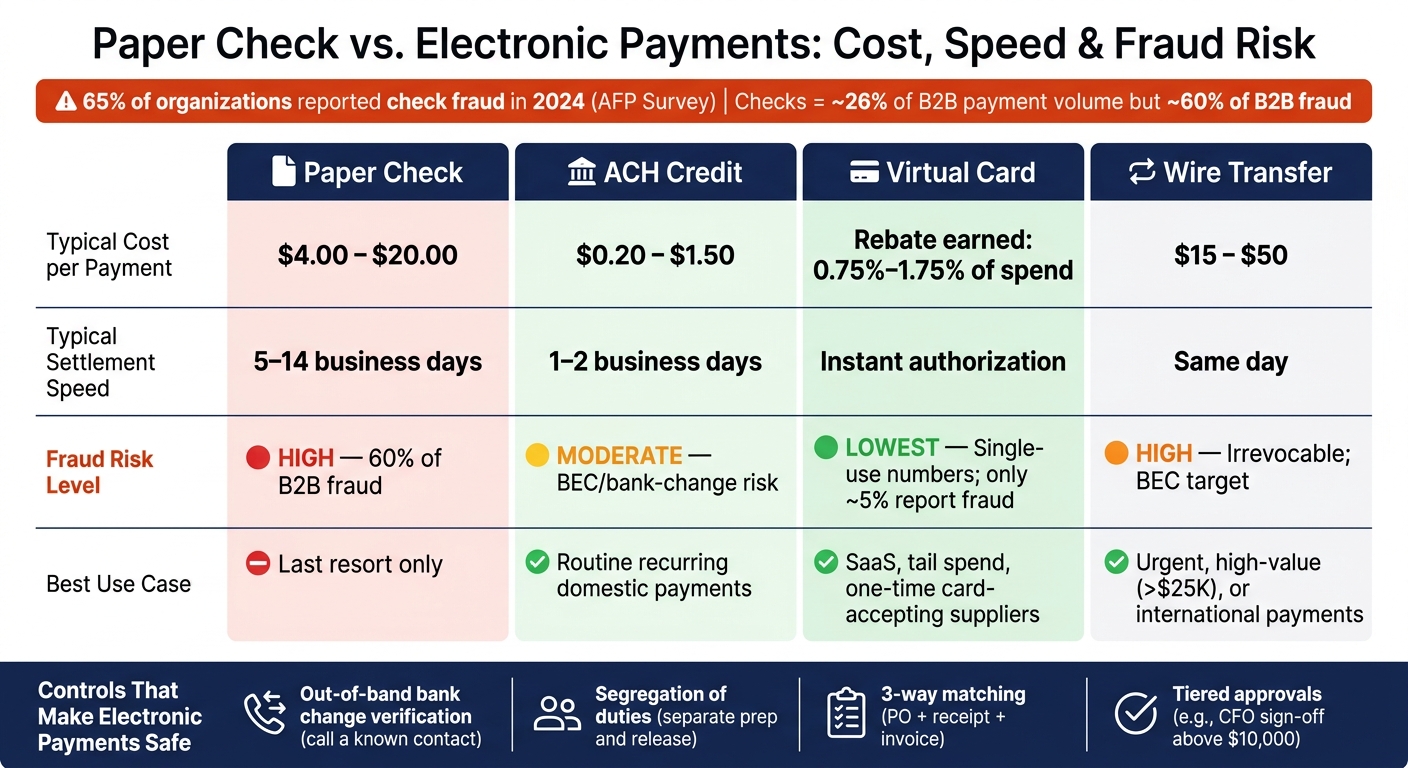
If I run AP, paper checks are the first thing I would cut. They can cost $4.00 to $20.00 per payment, take 5 to 14 business days, and sit at the center of a big share of B2B payment fraud.
Here’s the short version: I would use ACH for routine domestic payments, virtual cards for suppliers that take cards, and wires for urgent or high-dollar payments. That mix cuts cost, shortens payment time, and gives me better control over approvals, bank changes, and reconciliation.
The numbers make the case plain:
- Checks: $4.00 to $20.00 each, 5 to 14 business days, high fraud exposure
- ACH: $0.20 to $1.50 each, 1 to 2 business days
- Virtual cards: single-use card numbers, 0.75% to 1.75% rebate on eligible spend
- Wires: $15 to $50 each, same-day for urgent or high-value payments
- Check fraud: 65% of organizations reported it in AFP’s 2024 survey
- B2B fraud share: checks are about 26% of volume but about 60% of fraud
What I take from this is simple: use the lowest-cost payment method that still fits the supplier, timing, and control needs. Then lock it down with callback checks for bank-detail changes, separate prep and release duties, and approval rules inside the ERP.
| Payment Method | Typical Cost | Typical Speed | Best Use |
|---|---|---|---|
| Paper Check | $4.00–$20.00 | 5–14 business days | Last resort |
| ACH | $0.20–$1.50 | 1–2 business days | Recurring U.S. supplier payments |
| Virtual Card | May generate rebate | Near-instant authorization | SaaS, one-off buys, card-taking suppliers |
| Wire | $15–$50 | Same day | Urgent, high-dollar, or cross-border payments |
I also see one more point in the article: moving off checks works best when the process runs inside Oracle EBS, Oracle ERP Cloud, or JD Edwards with rule-based routing and audit trails, not email chains and manual follow-up.
ACH Payments Explained | Why Most Companies Get This Wrong
Electronic Payment Options That Replace Paper Checks
Once you move away from paper checks, the next step is simple: pick the right electronic payment method for each invoice.
For most U.S. AP teams, that doesn’t mean using just one option. It usually means a mix of ACH, virtual cards, and wire transfers. Each one fits a different kind of payment. The goal is pretty practical: send each invoice through the lowest-cost method that still works for timing, oversight, and risk.
That choice usually comes down to three things: payment size, supplier type, and the level of control you need.
ACH: The Default Choice for Routine Domestic Supplier Payments
ACH credits are the go-to option for routine domestic supplier payments. They usually settle in 1 to 2 business days and cost about $0.20 to $1.50 per transaction.
That low cost makes ACH the default for repeat payments. But there’s a catch: bank account changes are a major fraud point.
Treat any bank-detail change as high risk. Verify it by calling a known contact, not by replying to an email. In plain English, if a supplier says their banking info changed, your team should call a trusted number already on file. Callback verification should be mandatory for any bank change.
New Nacha rules taking effect in mid-2026 now require all ACH originators to use risk-based processes to verify vendor bank accounts.
For suppliers that accept card payments, virtual cards can add tighter controls and even bring some money back.
Virtual Cards: Tighter Controls, Better Security, and Potential Rebates
Virtual cards don’t work like ACH.
Instead of sending funds to a bank account, your AP system creates a single-use card number tied to one invoice, one supplier, and one amount. After settlement, that number expires. If it’s exposed, reuse is limited.
That’s a big reason many AP teams like them. Only about 5% of businesses report virtual-card fraud.
Virtual cards tend to work best for:
- tail spend
- SaaS subscriptions
- travel
- other one-time service providers that already accept card payments
There’s also a direct financial upside. AP teams usually earn a rebate of 0.75% to 1.75% on eligible spend.
When speed or payment value matters more than cost, wires come into play.
Wire Transfers and Portal-Enabled Payments for Urgent or High-Value Scenarios
Wires are the right choice when speed and finality matter more than price. They settle the same day and are often used for high-value transactions, usually above $25,000, such as M&A closings or urgent international payments.
The downside is pretty clear. Wires cost $15 to $50 per transfer, and they carry more fraud risk because they are irrevocable. That makes them a main target for Business Email Compromise.
For that reason, dual-control approval is a must for any wire payment: one person prepares it, and another person releases it.
Supplier portals help here too. They collect and update banking details through a secure workflow, which cuts down the risk that comes with email- and phone-based change requests. They also support ACH and card enrollment at scale.
Use the summary below to match each method to the right payment scenario.
| Payment Method | Typical Speed | Cost to AP | Risk | Best Fit |
|---|---|---|---|---|
| ACH Credit | 1–2 business days | $0.20–$1.50 | Moderate (BEC risk) | Routine domestic/recurring payments |
| Virtual Card | Instant authorization | Can generate rebates | Lowest (single-use) | Card-accepting suppliers; tail spend |
| Wire Transfer | Same day | $15–$50 | High (irrevocable) | High-value, urgent, or international |
How to Match the Right Payment Method to Each Supplier
Once your payment rails are set, the next move is simple: put each supplier on the lowest-cost payment method that still works for timing, control, and supplier acceptance.
A good rule of thumb is to sort suppliers by how they get paid. Think in terms of recurring payments, suppliers that take cards, and vendors tied to urgent or high-dollar transactions. That makes it much easier to assign the right rail without turning AP into a mess.
Virtual cards can also help soften processing costs because rebates may offset part of the expense. Here’s how the most common AP scenarios line up with the best-fit method and the controls that should sit behind each one.
| Scenario | Best-Fit Method | Required Controls |
|---|---|---|
| Recurring utilities/rent | ACH or Virtual Card | Approved supplier master data; verified bank details |
| Professional services | ACH or Virtual Card | 3-way match (invoice to contract/PO); verified bank details |
| SaaS/digital subscriptions | Virtual Card | Spend caps; merchant category code restrictions |
| One-off purchases | Virtual Card | Single-use number; immediate reconciliation |
| Urgent strategic supplier | Wire | Dual-control release; verified beneficiary details |
| International suppliers | Wire | FX rate verification; verified beneficiary details |
| Small, infrequent vendors | Virtual Card | Secure onboarding portal; tax ID validation |
Of course, these rules only hold up if your ERP enforces the process. Supplier data, approvals, and payment release all need to run through workflow controls. Otherwise, even the right rail can become risky.
Which Payment Method Fits Which Supplier Scenario
The fit usually comes down to a few practical patterns:
- ACH Credit works well for repeat domestic payments like rent, utilities, and many service invoices.
- Virtual Card makes sense for card-accepting suppliers, subscriptions, and one-time buys where tighter spend limits matter.
- Wire is usually the better choice for urgent payments, high-value transactions, and international suppliers.
- ACH can work for smaller, occasional vendors when onboarding and tax checks are locked down.
Controls That Make Electronic Payments Safer Than Checks
Changing payment rails by itself doesn’t cut fraud. The controls around the payment are what make the difference.
The biggest one is out-of-band verification for any bank account change. If a supplier sends an email saying their banking details changed, don’t just trust the message. Call a known contact using a verified phone number already on file and confirm the update directly. That one step can stop a lot of bad payments before they happen.
Segregation of duties is also a hard line. The person preparing a payment should not be the same person releasing it. Add tiered approval workflows on top of that, so smaller invoices get department-level approval while larger ones need extra sign-off, such as CFO approval for anything above $10,000.
For ACH debits, keep clear authorization records for B2B entries so your process stays aligned with NACHA requirements. It also helps to use ACH debit blocks or filters to allow only approved originators and set dollar caps.
Then there’s 3-way matching. Comparing the purchase order, goods receipt, and vendor invoice before releasing payment is what makes fast electronic payments safer to use at scale.
How AP Express and Oracle ERP Work Together to Scale Electronic Payments
Picking the right payment rail for each supplier is only part of the work. The other part is making sure your ERP applies that choice every single time, without someone stepping in by hand. That’s where AP Express fits in.
AP Express applies payment rules inside Oracle workflows, so teams don’t have to rely on manual follow-up. In plain English: the system doesn’t just suggest what should happen. It helps make sure it does happen.
Supplier Onboarding, Payment Setup, and Bank Change Controls in AP Express
AP Express replaces email-based supplier intake with a secure portal. Supplier bank and tax data flow into Oracle through an approval workflow instead of bouncing around inboxes.
When bank details change, AP Express triggers a hold and verification workflow before Oracle supplier records are updated. That matters because bank changes are one of those moments where things can go sideways fast. With this setup, every action is logged on its own, which supports SOX compliance and internal audit requirements.
That same control layer also carries supplier data into payment processing, so teams aren’t rekeying information or chasing down missing details.
Automating Approvals and Payment Execution Across Oracle EBS, ERP Cloud, and JD Edwards
AP Express routes approved invoices to ACH, virtual card, or wire based on supplier preference, invoice amount, and payment urgency. It pulls approved invoices from the ERP, executes the disbursement on the right rail, and sends settlement and reconciliation details back to the GL on its own.
The result is a bidirectional sync that keeps Oracle payment status current without manual updates across systems. So instead of AP staff checking one system, then another, then making fixes by hand, the status stays aligned across Oracle EBS, ERP Cloud, and JD Edwards.
What AP Teams Can Expect to Measure After Moving Away from Checks
Once payment routing and controls are automated, the gains show up in numbers AP teams can track. Common areas include invoice cycle time, month-end close, rebate income, and fraud exposure.
| Metric | Manual/Check-Based | Automated/Electronic |
|---|---|---|
| Invoice cycle time | 17.4 days | 3.1 days |
| Month-end close | ~10 days | ~4 days |
| Virtual card rebate potential | None | Up to ~$43,000/year avg. |
| Fraud exposure | Higher | Lower |
Virtual card programs also add a revenue angle. AP teams that focus on card enrollment for suppliers that accept cards can generate rebate income. AP Express clients average about $43,000 per year in virtual card rebates.
As check volume shifts to verified electronic rails, fraud exposure also goes down.
Conclusion: A Clear Path to Fewer Checks and Stronger AP Control
Once the savings and control gains are plain to see, the next move is making that shift last. Paper checks are still the slowest, most expensive, and most fraud-prone payment rail in AP.
The answer isn’t complicated. ACH works well for routine domestic payables, virtual cards make sense for vendors that accept cards or carry more risk, and wires are best for urgent or high-value payments. The key is matching the right rail to each supplier so you cut cost without losing control.
That’s where automation helps. When it’s connected to Oracle EBS, ERP Cloud, or JD Edwards, AP Express applies the selected payment rail, approval flow, and reconciliation rules without manual chasing or extra follow-up.
The payoff is straightforward: lower processing cost, less fraud exposure, a faster close, and better AP visibility.
FAQs
How do I decide which suppliers should move to ACH, virtual cards, or wires first?
Start by looking at the last 90 days of payment data. Then pull out your top 20 vendors by payment frequency. That group is the best place to start because they account for a large share of your payment activity.
For most suppliers, make ACH your default payment method. Use virtual cards for one-time payments, vendors with more risk, or payments that qualify for rebates. Save wires for urgent, high-dollar, or time-sensitive transactions.
What internal controls should we put in place before replacing paper checks?
Before you replace paper checks, tighten the basics first: data quality, vendor change controls, and payment approvals. Your ERP should hold clean, payment-ready records so you can cut down on reconciliation mistakes.
Handle bank detail changes like a fraud risk. That means requiring dual confirmation through a separate channel before anything gets updated. On top of that, require dual approvals, use three-way matching against purchase orders and delivery receipts, and limit access to the payment system based on role.
How can ERP-integrated automation reduce payment fraud and reconciliation work?
ERP-integrated automation helps cut fraud by shifting payments to secure digital rails like virtual cards. These cards use single-use, transaction-specific numbers, which limits exposure if card details are intercepted.
It also takes manual entry and scattered bank portals out of the process. Instead, payments move through one centralized workflow with built-in checks, which makes the whole flow easier to control.
For reconciliation, the system automatically captures remittance data and maps each payment back to the matching PO and invoice in your ERP. That means less manual matching, fewer re-keying mistakes, better real-time visibility, and audit trails that stay accurate.
Related Articles

How to Prevent Check Fraud: AP Controls That Work
July 14, 2026 Check Fraud Is Still an AP Problem - And Weak Controls Make...
Clean 1099 Reporting Starts Early: Use a Supplier Portal to Validate Vendor TINs
July 9, 2026 1099 problems usually start long before January. If I wait until year-end...