Top 7 Benefits of Oracle ERP AP Integration
Oracle ERP AP integration connects accounts payable systems directly to Oracle ERP platforms like Oracle ERP Cloud, E-Business Suite (EBS), and JD Edwards. This integration automates invoice processing, improves financial visibility, and reduces costs. Here’s a quick overview of the main benefits:
- Faster Invoice Processing: Automation reduces manual tasks, cutting processing time by over 75% and enabling approvals in days instead of weeks.
- Improved Financial Visibility: Real-time data syncing and dashboards provide instant access to critical financial information for better decision-making.
- Lower Costs: Processing costs drop from $11 per invoice to under $2, while automation ensures early payment discounts and eliminates late fees.
- Fewer Errors and Fraud: AI-driven tools achieve 99.7% accuracy in data capture, reducing mistakes and preventing duplicate payments or fraud.
- Better Supplier Relationships: Self-service portals and on-time payments simplify communication and strengthen trust with vendors.
- Simple Integration and Scalability: Pre-built modules ensure quick setup, while cloud platforms handle growing invoice volumes without adding staff.
- Stronger Compliance: Automated controls, audit trails, and real-time updates simplify regulatory compliance and reduce risks.
These advantages transform accounts payable from a manual, time-consuming process into an efficient, automated system that supports better financial management.
1. Faster Invoice Processing
Handling invoices manually can be both time-consuming and costly. On average, businesses spend over $11 to process a single invoice, with labor making up more than 60% of the typical accounts payable (AP) department’s budget.
By integrating Oracle ERP with accounts payable systems, these inefficiencies are drastically reduced. AI-driven data capture and real-time synchronization replace manual data entry. Using OCR (Optical Character Recognition) technology, the system extracts invoice details – like header and line-item data – from digital or scanned documents. It then matches this information against purchase orders and receipts stored in Oracle ERP, enabling automated validation, coding, and posting – all without human involvement. This approach not only cuts down on manual work but also speeds up the entire invoice processing cycle.
In fact, automated AP departments can process invoices in less than 25% of the time it takes using manual methods. With Oracle ERP integration, businesses can reduce invoice processing times from weeks to just a few days.
“We selected AP Express due to its remarkable flexibility and scalability… it significantly enhanced our data capture process.” – Miguel Monzon, IT Business, Coeur Mining
Faster processing doesn’t just save time – it also improves supplier relationships. Quick approval cycles allow businesses to take advantage of early payment discounts, such as 2/10 net 30 terms, which lower purchasing costs and foster trust with suppliers. Additionally, automated exception management flags discrepancies and routes them back to suppliers for resolution without the need for manual follow-ups.
2. Better Financial Visibility and Reporting
Integrating Oracle ERP with cloud-based AP solutions gives finance teams instant access to critical financial data. This real-time access enables faster reconciliations and tighter control over spending. Teams can monitor invoice statuses, financial obligations, and cash flow needs in real time, providing the clarity needed to make informed decisions. For instance, AP personnel gain immediate visibility into purchase orders as soon as they’re created, streamlining the reconciliation process and improving spend management. This level of transparency paves the way for insights that can transform how financial strategies are shaped.
Advanced analytics further enhance this visibility. Tools can highlight how Days Payable Outstanding (DPO) impacts cash flow and identify vendors with recurring discrepancies. Additionally, AI-driven discount modeling helps finance leaders select the most cost-effective early payment options, ensuring working capital is optimized. Automated master data synchronization ensures that every report reflects the latest operational data.
The cost-saving potential is substantial. Companies using AP automation have reported a 50% reduction in invoice processing costs and a 30% improvement in payment accuracy. Real-time dashboards provide a comprehensive view of AP transactions, supporting data-driven decision-making for CFOs and other executives. These dashboards also create detailed audit trails that cover every step of the invoice lifecycle.
Centralized data plays a key role in speeding up processes and strengthening financial controls. By working from a unified platform, teams benefit from automated GL coding that ensures financial reports align with business rules and account structures. This eliminates data silos and maintains full audit trails from invoice receipt to final payment.
3. Lower Costs and Higher ROI
Integrating Oracle ERP with AP automation can lead to noticeable cost savings in several areas. On average, manual invoice processing costs businesses $11 per invoice. In contrast, highly automated AP departments spend less than one-fourth of the time processing each invoice. These savings start adding up immediately and pave the way for long-term financial returns.
Automation reduces expenses tied to data entry and paper-based processes. With tools like AI-powered data capture and optical character recognition, manual data entry time drops by 80% – from 5–8 minutes to under 1 minute per invoice. Automated three-way matching further helps by cross-checking invoices with purchase orders and receipts in real time, avoiding overpayments and duplicate payments. Moving to digital workflows also eliminates costs for physical storage, paper, and postage.
The financial benefits go beyond just labor savings. Automation ensures businesses consistently capture early payment discounts. By reducing invoice approval cycles from 10 days to just 1–2 days, companies can take advantage of discounts that manual processes often miss. Dynamic discounting tools can recommend which suppliers should be paid early, calculating the best discount rates based on available cash flow. Additionally, manual processing often results in late payment fees, which can cost mid-sized businesses $500–$2,000 per month – a problem automation virtually eliminates.
Another advantage is scalability. Cloud-based automation allows AP departments to handle 2–3 times more invoices without needing to expand their teams. This means companies can grow their operations without a matching increase in AP expenses.
Supplier portals further reduce administrative burdens by letting vendors check payment statuses and submit invoices themselves, cutting down on back-and-forth inquiries. Automated GL coding ensures accuracy during month-end closes, minimizing the need for manual reconciliation. Together, these efficiencies create a compounding financial return that grows as transaction volumes increase.
4. Fewer Errors and Fraud Risks
Handling invoices manually comes with its share of risks. Errors in manual data entry for paper invoices can exceed 3.6%, leading to issues like duplicate payments and disputes with vendors. By integrating Oracle ERP with AP automation, these problems are largely addressed through automated data capture and validation.
Using AI-driven OCR technology, invoice data is extracted with an impressive 99.7% accuracy, significantly cutting down on human mistakes. The system performs automated three-way matching, cross-referencing invoices with purchase orders and delivery receipts stored in Oracle ERP. This ensures payments are only made for items actually received and at the agreed price. Additionally, real-time validation identifies duplicate invoices, mismatched units, or partial shipments before any payment is processed. Companies adopting this level of automation have seen a 30% improvement in payment accuracy.
Fraud prevention is also bolstered with robust system controls. The integration keeps supplier master data updated in real time, blocking unauthorized “ghost” vendors from entering the system. Automated approval workflows prevent any single individual from both entering and approving a payment. Every transaction and modification is logged digitally, creating a clear audit trail for complete transparency. With 53% of finance professionals reporting exposure to deepfake scams, these safeguards are critical for protecting financial operations.
The benefits go beyond just cutting immediate costs. Automated AP systems can slash invoice processing expenses from an average of $15 per invoice to under $2. They also help reduce compliance-related risks by 35%. By avoiding costly errors and fraud, organizations not only save money but also strengthen their reputation and foster better relationships with suppliers. These improvements support more reliable and efficient financial management overall.
5. Better Supplier Management and Relationships
Strong supplier relationships depend on clear communication, accurate data, and timely payments. By integrating Oracle ERP with cloud-based AP automation, suppliers can access self-service portals to submit invoices, check real-time payment statuses, and update their account details – all without needing to contact the AP team directly. This level of transparency reduces the need for back-and-forth communication through phone calls or emails, making interactions smoother and more efficient. It also enables faster supplier onboarding and ensures data remains accurate.
Automated systems simplify the onboarding process by verifying vendors against existing electronic payment records. With OCR technology and automated data enrichment, vendor details like payment terms and due dates are extracted directly from Oracle ERP master data with up to 90% accuracy. If there are discrepancies, the system flags missing information and sends clarification requests straight to the supplier, cutting out the need for manual intervention by AP staff.
Quicker approval cycles help businesses strengthen supplier relationships by ensuring consistent, on-time payments. They can also cater to each vendor’s preferred payment method, whether it’s virtual cards, ACH, or another option. This consistency fosters trust and encourages better collaboration with key suppliers.
Real-time synchronization between systems ensures Oracle ERP remains the central source of truth for supplier data. Updates made in one system are instantly reflected in the other, eliminating data silos and ensuring all interactions are traceable for audits. This accuracy allows businesses to negotiate better contract terms and secure favorable payment conditions with strategic vendors. Reliable data and timely payments give companies the leverage needed to manage credits effectively and maintain strong supplier partnerships.
6. Easy ERP Integration and Scalability
Alongside quicker processing and improved supplier engagement, seamless integration and adaptability are key to streamlining operations. Cloud AP solutions designed for Oracle ERP systems connect directly, eliminating the need for custom coding or extensive IT involvement. With pre-built integration modules, these systems pull master data – like suppliers, business units, chart of accounts, purchase orders, and receipts – from Oracle ERP Cloud or E-Business Suite in real time. This approach enables rapid setup and ensures the ERP remains the central source of truth, while AP systems handle invoice processing, approvals, and payments.
By using native integration, businesses avoid manual data exports or relying on custom middleware, which can become unreliable with Oracle’s regular quarterly updates. Modern cloud AP platforms handle updates automatically to stay compatible with Oracle’s latest releases. Additionally, secure HTTPS communication initiated by the ERP ensures the protection of core systems. This dependable connection also makes it easier to grow and adapt as business needs change.
Scalability is another major benefit. Serverless platforms can expand on demand, accommodating a few users or scaling up to hundreds without delay. For example, switching to a serverless setup can boost user capacity by up to 400%, increasing from 10 to over 50 users, all while cutting costs. This means businesses can handle two or three times the invoice volume without needing to expand their accounting teams.
Advanced features like AI-powered capture and automated matching allow for straight-through processing, speeding up invoice handling by up to 80% compared to older, on-premises systems. As transaction volumes grow – whether across multiple entities or international markets – the platform manages multi-currency transactions and varying tax systems effortlessly, without requiring manual adjustments.
7. Stronger Compliance and Risk Management
Expanding on the benefits of fewer errors and improved supplier relationships, integrating Oracle ERP with AP automation takes compliance and risk management to the next level. Automated controls and audit trails make staying compliant much easier. For instance, most customers enforce three-way matching, which blocks unauthorized payments before they happen. Additionally, the system ensures segregation of duties, preventing any single individual from managing all parts of a financial transaction – this helps reduce the risk of fraud.
Every transaction is accompanied by a fully traceable history. As Hari Sethalapathy, Managing Director at Winfo Solutions, notes: “Automated workflows ensure that all transactions are recorded accurately and are easily traceable, simplifying compliance and audits”. This real-time documentation removes the stress of scrambling to gather records during regulatory inspections. Companies using AP automation have reported a 30% boost in payment accuracy and a 20% to 30% cut in audit costs.
Cloud-based systems also automatically adapt to new regulations and tax frameworks. While setting up these controls might take extra time initially, they significantly lower long-term compliance risks and reduce annual costs. These automated safeguards not only build on earlier efficiency improvements but also equip your team to handle future risk management challenges.
Tracking supplier compliance becomes more manageable with vendor portals. Suppliers can update their own information and check invoice statuses in real time, cutting down on manual data entry errors. Meanwhile, AI tools handle up to 90% of vendor inquiries by pulling data directly from the ERP system.
To protect sensitive financial data, HTTPS protocols and encryption are employed. AI-driven general ledger (GL) coding achieves up to 97% accuracy, further reducing the need for manual corrections. Together, these features – automated controls, transparent audit trails, and intelligent exception management – create a scalable compliance framework. This setup not only minimizes risk exposure but also lightens the workload for your finance team.
Platforms like AP Express take full advantage of these automated controls and audit trails, helping organizations maintain compliance while effectively managing risks.
Manual vs. Automated AP: Comparison
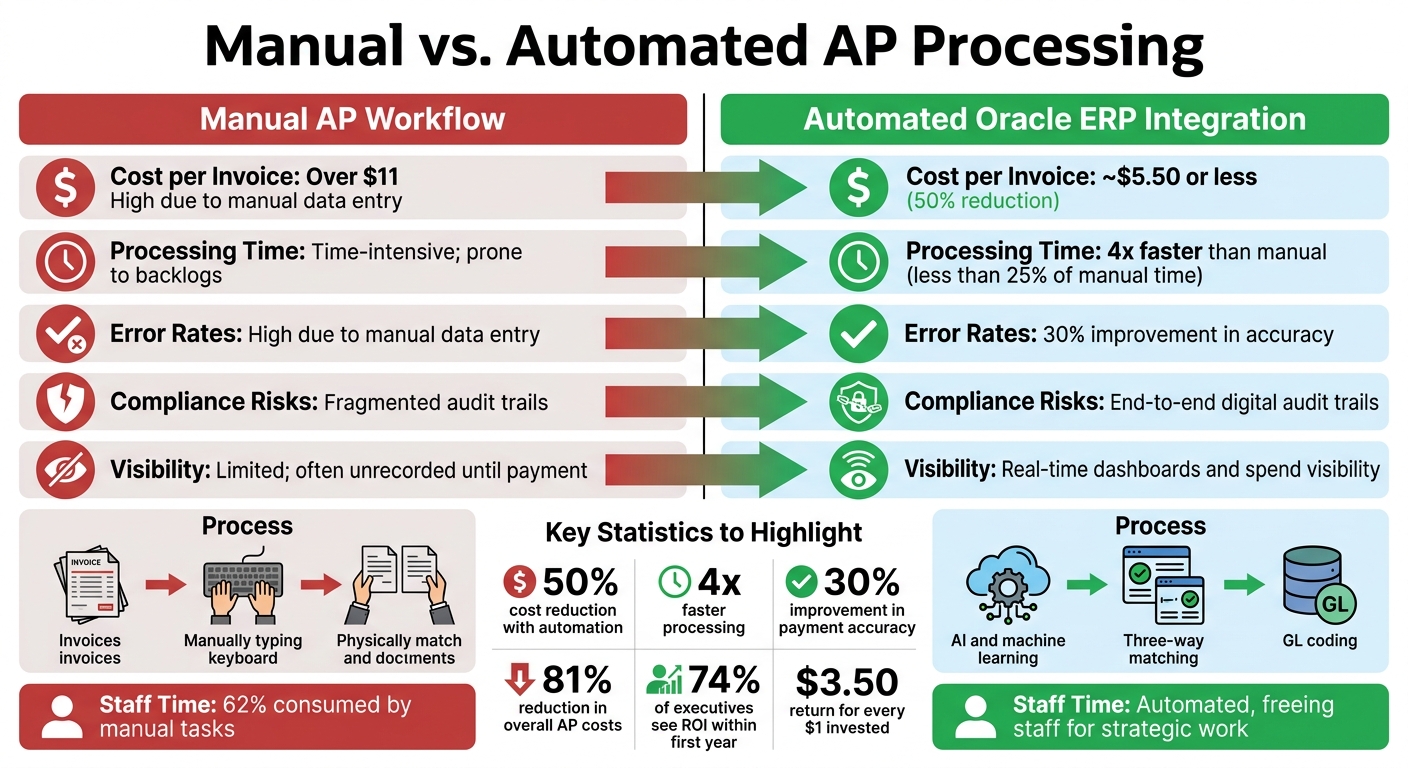
When comparing manual AP workflows to automated Oracle ERP integration, the differences are stark. Manual processes rely on paper invoices, manual data entry, and physical document matching, which often leads to delays, especially when documents are lost or approvers are unavailable. On the other hand, automated systems leverage AI and machine learning to handle tasks like data capture, three-way matching, and GL coding, eliminating the need for human intervention.
One of the most noticeable differences is cost. Processing a single manual invoice costs businesses over $11. Automation, by contrast, slashes this cost by 50%, reducing it to around $5.50 or less per invoice. This cost reduction stems from eliminating manual tasks, which currently consume 62% of AP staff time. Automated processes are also significantly faster, requiring less than one-fourth of the time needed for manual workflows.
Here’s a quick breakdown of the key differences:
| Metric | Manual AP Workflow | Automated Oracle ERP Integration |
|---|---|---|
| Cost per Invoice | Over $11 | ~$5.50 or less (50% reduction) |
| Error Rates | High due to manual data entry | 30% improvement in accuracy |
| Processing Time | Time-intensive; prone to backlogs | 4x faster than manual |
| Compliance Risks | Fragmented audit trails | End-to-end digital audit trails |
| Visibility | Limited; often unrecorded until payment | Real-time dashboards and spend visibility |
Error rates also see a marked improvement with automation. Manual workflows are often riddled with errors from hand-keying and document handling. Automated systems, using tools like OCR and AI, reduce payment errors by 30%. Additionally, automation allows businesses to scale invoice processing without needing to increase staff – something manual processes simply can’t accommodate.
One standout solution, AP Express, integrates seamlessly with Oracle ERPs, enabling real-time data exchange and improving invoice processing. Companies using automation report that 74% of executives see ROI within the first year, with an average return of $3.50 for every $1 invested in AI-driven AP solutions.
Conclusion
Bringing cloud AP solutions into the fold with Oracle ERP can completely reshape how accounts payable operates, turning it into a streamlined and impactful part of your business. With end-to-end automation, invoices flow seamlessly, financial data stays updated in real time, and your team can shift their focus from tedious manual tasks to strategic financial planning. This kind of integration offers the flexibility and efficiency needed to make smarter financial decisions.
The benefits go far beyond just saving time. Automation can cut invoice processing costs from $15 to less than $2 and reduce processing times dramatically, lowering overall AP costs by as much as 81%. Companies using these solutions often see financial close times improve by 25% and cash flow forecasting accuracy jump by 40%. These aren’t minor tweaks – they signal a complete transformation in AP operations.
For Oracle ERP users, AP Express delivers a solution tailored to their needs. Designed by Oracle ERP experts and leveraging Oracle-authorized integration methods, it ensures your ERP remains the central hub for real-time data synchronization, including suppliers, purchase orders, GL codes, and more.
“AP Express has helped us automate our end-to-end AP process while providing our team with the visibility they need to approve invoices and make better financial decisions. It is a solution that lets us manage our entire business more effectively.”
– Tiffany Thomas, AP Manager, AMLI Residential
If you’re an Oracle ERP user aiming to eliminate manual inefficiencies, AP Express offers a scalable, hands-off solution. It handles all updates and maintenance to stay compatible with Oracle ERP Cloud versions, ensuring your system operates smoothly without added hassle.
FAQs
How long does Oracle ERP AP integration take to implement?
The process of integrating Oracle ERP AP can take as little as 30 business days. The exact timeline depends on several factors, including the scope and complexity of the project and the unique needs of your organization.
What data needs to sync between Oracle ERP and an AP automation system?
Data that must sync encompasses invoice details, approval statuses, payment information, and real-time invoice updates. Keeping this data aligned ensures precise processing, improved visibility, and smoother accounts payable workflows.
What security and compliance controls are included in Oracle ERP AP integration?
Oracle ERP AP integration incorporates strong security and compliance features to safeguard sensitive data. These include IP address restrictions , role-based access controls, and advanced authentication methods. We can also easily work with your Single Sign On client. Together, these measures ensure that only authorized users can access the system.
Related Articles

How to Build Trust in Your Financials and Close Faster
January 25, 2022 Finance Has a Problem A recent survey by the AICPA revealed some...
How AP Automation Improves Cash Flow Forecasting
June 3, 2026 Accurate cash flow forecasting is critical for making smart financial decisions, but...