How Supply Chain Finance Improves Cash Flow
Supply chain finance (SCF) helps businesses manage cash flow by allowing suppliers to get paid faster and buyers to extend payment terms. Here’s how it works: a third-party financier pays the supplier early (within 24–48 hours of invoice approval) at a discounted rate, while the buyer repays the financier later, often on extended terms. The process leverages the buyer’s credit rating, making borrowing cheaper for suppliers and freeing up working capital for buyers.
Key Benefits of SCF:
- For Buyers: Extend payment terms (e.g., from 30 to 90 days) to improve liquidity.
- For Suppliers: Access funds quickly without relying on costly loans.
- For Both: Shorten the cash conversion cycle and stabilize supply chains.
SCF Models:
- Reverse Factoring: Early supplier payments funded by a financier, using the buyer’s credit rating.
- Dynamic Discounting: Buyers use surplus cash to pay suppliers early in exchange for discounts.
- Invoice Discounting: Suppliers borrow against receivables, though at higher rates.
SCF is particularly useful in industries with tight margins and long payment cycles, such as manufacturing and automotive. It reduces financial strain, improves supplier operations, and minimizes supply chain disruptions.
Getting Started:
- Assess your accounts payable (AP) efficiency and supplier payment terms.
- Automate invoice approvals to speed up the process.
- Onboard suppliers with clear communication about SCF benefits.
- Track metrics like Days Payable Outstanding (DPO) and supplier participation to measure success.
SCF is a practical tool for improving cash flow and maintaining strong supplier relationships, especially during economic uncertainty.
Here’s How Supply Chain Finance Can Help Improve Cash Flow
How Supply Chain Finance Improves Cash Flow
Key Metrics Affected by SCF
Supply chain finance (SCF) plays a critical role in improving three key financial metrics: Days Payable Outstanding (DPO), Days Sales Outstanding (DSO), and the cash conversion cycle (CCC).
For buyers, extending DPO – stretching payment terms from the typical 30 days to 60, 90, or even 120 days – provides more time to hold onto cash. This extra liquidity can be used for initiatives like growth, research and development, or reducing debt. On the supplier side, SCF allows invoices to be converted into cash within just 24–48 hours, rather than waiting 60–120 days. This faster access to funds helps suppliers improve their operations and financial stability. Together, these adjustments shorten the overall cash conversion cycle, unlocking working capital tied up in the supply chain.
| Working Capital Lever | Buyer Impact | Supplier Impact |
|---|---|---|
| Extend Payment Terms | Increases liquidity by extending payment timelines | Alleviates cash flow issues with early payment options |
| Accelerated Receipts | Ensures continuity of supply by aiding suppliers’ cash flow | Speeds up cash availability for better financial planning |
| Forecast Accuracy | Aligns payments with approved liabilities | Provides clarity on invoice eligibility and funding timelines |
SCF Models and How They Affect Cash Flow
Different SCF models influence cash flow in unique ways, depending on how and when payments are processed.
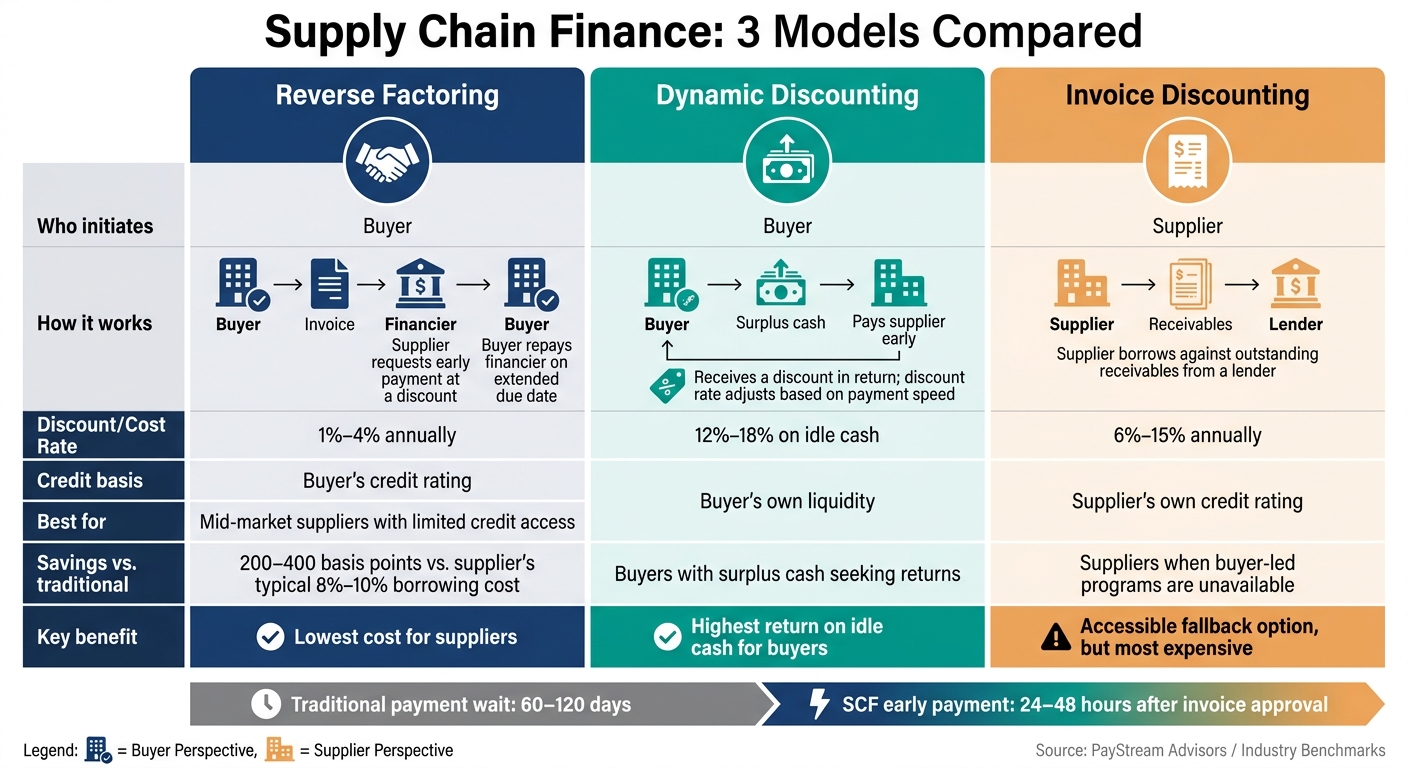
Reverse Factoring: In this setup, once a buyer approves an invoice, the supplier can request early payment from a financier at a discounted rate. The discount – typically 1%–4% annually – is based on the buyer’s credit rating rather than the supplier’s. The buyer repays the financier on the original or extended due date. This model is particularly beneficial for mid-market suppliers, who often face borrowing costs of 8%–10%, saving them 200–400 basis points.
Dynamic Discounting: Here, buyers use their available cash to pay suppliers early in exchange for a discount. The discount rate adjusts based on how quickly the payment is made, offering buyers annualized returns of 12%–18% on their idle cash.
Invoice Discounting: This model allows suppliers to borrow against their receivables, but at higher rates – usually between 6% and 15% annually. While it can be a helpful fallback when buyer-led programs aren’t available, it doesn’t offer the cost efficiencies of reverse factoring.
When SCF Delivers the Most Value
SCF proves especially valuable in industries with tight profit margins and long payment cycles, such as manufacturing, automotive, and commodities. For instance, in the automotive sector, SCF pricing averages about 2.5% annually, compared to the 8%–12% seen with traditional factoring.
Take the example of Industrial Scrap Processors, Inc., a family-owned business in Bessemer, Alabama. When one of its major steel mill customers extended payment terms from 45 to 90 days, the company faced a severe cash flow crunch. By joining an SCF program, it gained immediate access to cash for its receivables. This allowed the firm to continue paying its own suppliers on 30-day terms, preserving its profitability.
SCF also shines when working with smaller suppliers who often struggle with cash flow. Many of these businesses don’t have access to affordable credit, and financial stress in the supply chain has been linked to a 25% increase in defect rates and a 50% rise in lead-time variability. As Mark White from ProcurementNation explains:
“The gap between shipment and payment – often 60, 90, or 120 days – forces desperate choices, from taking loans at 30%+ APR to deferring maintenance.”
During times of economic uncertainty, SCF becomes even more critical. For example, in the year following the COVID-19 pandemic, supply chain finance fund volumes grew by 38% as companies turned to SCF to stabilize supplier relationships under extreme cash pressures. In challenging periods, SCF acts as a financial safety net, helping to keep supply chains intact.
These advantages highlight why preparing your organization for SCF implementation is an essential step forward.
How to Prepare Your Organization for Supply Chain Finance
Assessing Your Current Cash Flow and Payables Operations
Before starting a supply chain finance (SCF) program, it’s crucial to understand how your accounts payable (AP) function is performing. One key area to focus on is your invoice approval cycle time. If it takes more than 10 days to approve an invoice, your financing window shrinks, which can make SCF less attractive to suppliers.
“If invoices aren’t being approved within a week of receipt, the priority should be procurement automation and AP process improvement before launching a supply chain finance program.” – PayStream Advisors
Start by analyzing your Oracle ERP data to review current Days Payable Outstanding (DPO) figures. Identify suppliers with long payment terms, high spending concentration, or strategic importance. Mid-tier suppliers with moderate credit ratings often benefit the most from reverse factoring, so focusing on them can maximize SCF impact. If you’re considering dynamic discounting, pinpoint which currencies hold surplus cash, as this will determine where early payment offers yield the best returns.
| Assessment Area | Key Metric | Target for SCF Readiness |
|---|---|---|
| AP Efficiency | Invoice approval cycle time | Under 10 days (ideally 3–5 days) |
| Working Capital | Days Payable Outstanding (DPO) | Identify room for term extension |
| Supplier Data | Payment method | Electronic/digital |
| Cash Position | Surplus liquidity | Identified by specific currency |
| ERP Status | AP Express | Live on AP Express |
Once you’ve assessed your AP performance, you can define clear objectives for your SCF program.
Setting SCF Objectives and Policies
Using your performance assessment as a foundation, establish specific SCF goals. Common objectives include extending DPO to free up working capital, improving supplier liquidity to strengthen the supply chain, and earning returns on surplus cash through dynamic discounting. Avoid pursuing all these goals at once without prioritization, as it can dilute the program’s effectiveness.
Set measurable targets. For instance, aim to extend DPO from 45 to 75 days for a specific supplier group, achieve a defined supplier participation rate, or meet an approval cycle time benchmark. A good example is Caterpillar Inc.’s 2024 SCF initiative with J.P. Morgan, led by VP & Corporate Treasurer Patrick McCartan. Their approach focused on two clear goals: optimizing working capital and maintaining a resilient supply base. This clarity guided their policy decisions.
Additionally, ensure compliance policies are in place from the start. Under FASB ASU 2022-04, U.S. companies must disclose key terms and outstanding amounts of supplier finance programs. Preparing disclosure protocols early helps you stay ahead of audits and investor scrutiny.
Before moving forward, confirm that your ERP and AP automation systems are ready to support SCF.
Checking ERP and AP Automation Readiness
Your ERP and AP systems form the backbone of any SCF program. Confirm that your Accounts Payable module is live and properly configured to support supplier participation. Ensure that ERP legal entity names exactly match the financing bank’s DDA to prevent integration issues.
SCF success depends heavily on fast and reliable invoice approvals. Automated invoice digitization and streamlined workflow approvals are critical. Tools like AP Express can integrate with Oracle EBS, ERP Cloud, and JD Edwards, reducing approval times to the 3–5 day range that suppliers find economically viable.
“The organizations that extract the most value from SCF have already invested in the operational foundation: efficient AP processing, reliable invoice approval, clean supplier data, and standardized payment terms.” – PayStream Advisors
How to Implement Supply Chain Finance to Improve Cash Flow
Designing Your SCF Program
Once you’ve assessed your accounts payable (AP) operations and set clear objectives, the next step is to structure your supply chain finance (SCF) program. The design should align with your goals and the policies you established earlier. Depending on your needs, you can choose from options like reverse factoring to extend payment terms, dynamic discounting to use surplus cash for returns, or a hybrid approach tailored to different supplier profiles.
Segmenting your suppliers effectively is key. Start by focusing on mid-tier suppliers – they often gain the most from lower borrowing costs, with rates reduced by as much as 200–400 basis points through reverse factoring. This rate difference creates value for both your suppliers and your organization.
“Supply chain finance lets suppliers get paid early using the buyer’s credit rating, while buyers maintain or extend payment terms.” – PayStream Advisors
After segmentation, establish clear eligibility rules. Define criteria like minimum invoice thresholds, approved payment terms, and which supplier tiers qualify for specific program types. These rules ensure the program stays manageable and allow your financing partner to assess risk accurately.
Once your SCF program is designed, the next step is to integrate it with your Oracle-based AP system for smooth execution.
Connecting SCF with Oracle-Based AP Systems
After finalizing your SCF model, it’s critical to integrate it seamlessly with your Oracle-based AP system. The primary requirement is ensuring that approved invoices in your ERP system automatically trigger data feeds to your financing provider. This enables suppliers to access early payments as soon as invoices are confirmed.
Fast invoice approvals are vital to making SCF work. Tools like AP Express can integrate with Oracle EBS, ERP Cloud, and JD Edwards, using AI-powered invoice digitization and automated workflows to cut approval times down to 3–5 days. This speed is crucial for making SCF attractive and economically viable for suppliers.
With the technical integration in place, the focus shifts to supplier onboarding.
Onboarding Suppliers and Managing Participation
A successful SCF program hinges on effective supplier onboarding. Translating your program design into real cash flow benefits requires getting suppliers to actively participate. The biggest hurdle to adoption isn’t the financial incentives – it’s often the complexity of the sign-up process and unclear communication about the program’s benefits.
“Programs with dedicated onboarding teams consistently achieve higher adoption rates.” – PayStream Advisors
Start small by rolling out the program to your top 20–30 strategic suppliers. Offer personalized onboarding support to this group and use their feedback to refine your approach before scaling up. Self-service supplier portals can make a big difference, allowing suppliers to enroll, track invoice statuses, and request early payments without needing to involve your AP team. Additionally, simulation tools that let suppliers preview discount rates and cash flow outcomes can simplify their decision-making process.
When reaching out, focus your messaging on what matters most to suppliers: faster access to cash, lower financing costs compared to traditional bank loans, and more predictable cash flow. Highlighting these benefits – rather than diving into the technical details of reverse factoring – is what will encourage suppliers to join your program.
How to Monitor, Improve, and Manage Risk in Supply Chain Finance
Once your supply chain finance (SCF) program is up and running, keeping a close eye on its performance is crucial to ensure it continues to deliver the desired cash flow benefits.
Tracking Key Performance Metrics
To keep your SCF program on track, consistent measurement is key. Start by monitoring Days Payable Outstanding (DPO) alongside supplier Days Sales Outstanding (DSO) to understand cash flow timing. These metrics help you evaluate how well the program balances working capital for both you and your suppliers.
In addition to financial metrics, operational signals provide critical insights. For instance, the median approval time for invoices should stay under five days – any delays here reduce the financing window. Similarly, metrics like first-pass acceptance rates and auto-reconciliation rates highlight whether your invoice data is accurate enough to support smooth funding. A rise in exceptions or disputes is a red flag that your processes may need fine-tuning.
| Operational Signal | What It Measures | Target |
|---|---|---|
| Median Approval (days) | Time from invoice receipt to buyer approval | Under 5 days |
| First-Pass Acceptance Rate | Invoices submitted without errors | As high as possible |
| Auto-Reconciliation Rate | Payments matched automatically in ERP | As high as possible |
| Dispute Aging | Average time to resolve invoice discrepancies | As low as possible |
Another key indicator is supplier participation. In well-managed programs, over 90% of suppliers typically opt for automatic discounting when interest rates are favorable. If participation is low, it might be worth revisiting your onboarding approach or simplifying the enrollment process.
With these metrics in place, you can make informed adjustments to improve your program’s performance over time.
Refining Your SCF Program Over Time
Data insights are invaluable for fine-tuning your SCF program. For instance, you can gradually extend payment terms – shifting from Net 30 to Net 60 – so long as it doesn’t strain supplier relationships.
Regular governance meetings are another way to keep the program aligned with your goals. Monthly check-ins between finance and procurement teams, focusing on shared KPIs such as early-payment utilization and payment accuracy, help ensure the program stays on track. These meetings also prevent unapproved changes to payment terms.
“Seamless alignment between finance and procurement is a necessity to optimize cash flow.” – Xavier Olivera, Lead Analyst, Spend Matters
As the program evolves, you might explore a hybrid approach. Combining reverse factoring with dynamic discounting allows you to adjust based on liquidity. When cash flow is strong, you can fund early payments internally for better returns. If cash preservation becomes a priority, you can rely on third-party funding instead.
Building Supply Chain Resilience with SCF
The benefits of SCF go beyond improving your balance sheet. Early payments can stabilize supplier operations, reducing the risk of supply chain disruptions. For example, a U.S. automotive company enabled early payments within two days of invoice approval for tier-2 suppliers on 60-day terms. This led to a 40% improvement in supplier cash flow stability and a 25% reduction in supply chain disruptions.
At the same time, managing concentration risk is critical. The 2021 collapse of Greensill Capital highlighted the dangers of depending on a single financier. Diversifying your funding sources can reduce this risk while strengthening the resilience of your supply chain.
Lastly, compliance matters. Ensure your program adheres to FASB ASU 2022-04 disclosure requirements, which mandate reporting key terms and outstanding amounts in supplier finance programs. Staying compliant avoids potential accounting complications.
Conclusion: Getting the Most Out of Supply Chain Finance
Supply chain finance works best when every piece of the puzzle fits together seamlessly. When buyers approve invoices quickly, suppliers can tap into lower early-payment costs. This not only strengthens supplier relationships but also enhances fulfillment reliability and creates a stronger, more adaptable supply chain.
Research shows that active supply chain finance (SCF) programs help reduce disruptions and improve on-time deliveries. These operational improvements aren’t just short-term wins – they offer lasting benefits. This highlights the importance of having efficient accounts payable (AP) systems in place.
AP automation plays a critical role here. Tools like AP Express are designed to integrate seamlessly with platforms like Oracle EBS, ERP Cloud, and JD Edwards. They streamline invoice processing, speed up approvals, and give suppliers real-time access to information via a self-service portal. With these capabilities, SCF programs can grow and deliver results more effectively.
FAQs
Is supply chain finance the same as a loan?
Supply chain finance isn’t the same as a loan. It’s a working capital solution that allows suppliers to get early payment on approved invoices by selling their receivables to a financier at a discount. The cost is usually determined by the buyer’s credit rating, which often makes it less expensive than traditional borrowing. When set up correctly, it’s typically not classified as financial debt on the balance sheet for either the buyer or the supplier.
Which SCF model is best for my business?
The best place to begin is with reverse factoring (also known as approved payables financing). This approach is driven by the buyer, kicking in once your team approves supplier invoices. It allows suppliers to choose early payment at a discount, leveraging your creditworthiness, while you stick to paying on the original due date. Alternatively, if you’d rather use your own cash to offer early-payment discounts without involving a third party, dynamic discounting might be the better choice.
What do I need in AP and ERP to launch SCF?
To get started with supply chain finance (SCF), it’s crucial to have your ERP system’s accounts payable module up and running, specifically for the suppliers who will be part of the program. Additionally, you’ll need to establish a trade finance program and secure a formal agreement with a financing provider.
For businesses using Oracle systems, tools like AP Express can simplify the process. These platforms help align supplier and purchase order data, ensuring invoices are accurate. Once invoices are approved, they can qualify for early payment options through your chosen finance provider.
Related Articles
ACH validation and NACHA compliance
July 21, 2026 A valid routing number is not enough. If you want ACH payments...
Don’t Be Late
January 25, 2022 The Diffusion of Innovation In a previous blog, we wrote about a...