Solving AP Sustainability Challenges with E-Payments
If you still pay suppliers by check, your AP process is slower, costs more, and creates more waste. I’d sum it up like this: moving to ACH, wires, and virtual cards cuts paper, trims manual work, lowers errors, and gives you cleaner payment data inside Oracle EBS, Oracle ERP Cloud, and JD Edwards.
Here’s the short version:
- I see paper checks and mailed invoices as the main source of waste, delays, and weak reporting
- Manual invoice work can cost $10.00 to $13.54 per invoice, while automated processing can drop that to $2.00 to $2.98
- Paper-based AP cycles average 17.4 days, and manual workflows come with error rates near 39%
- One paper check carries about 15g of CO2 from production and transport
- E-payments help shift AP to paperless payments, fewer fixes, and better audit trails
- AP Express supports this move with invoice automation, supplier enrollment, and payment routing for Oracle users
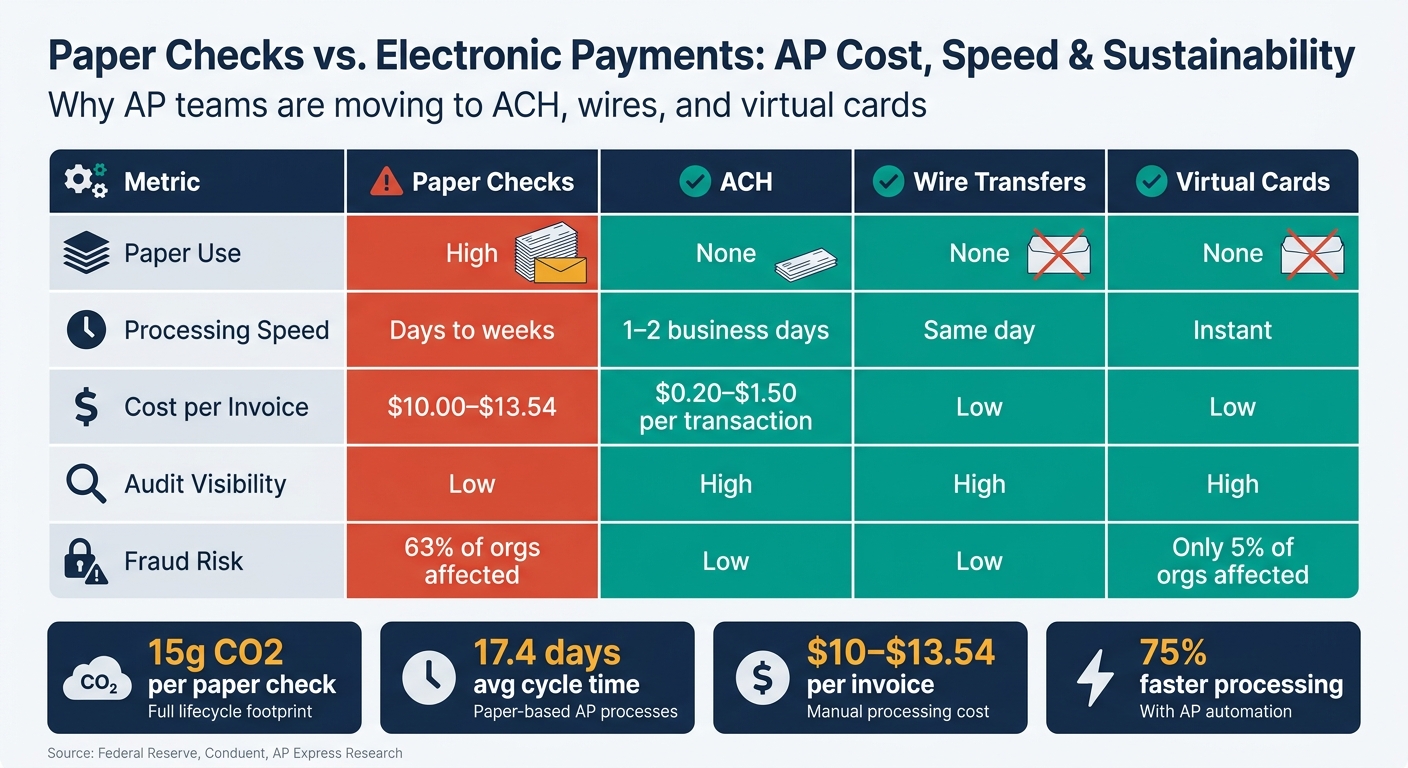
Quick comparison
| Method | Paper use | Speed | Visibility |
|---|---|---|---|
| Paper checks | High | Slow | Low |
| ACH | None | 1-2 business days | High |
| Wires | None | Same day | High |
| Virtual cards | None | Instant | High |
For me, the main point is simple: if you want lower AP waste, cleaner reporting, and more control, the fastest step is to move suppliers off checks and into electronic payments.
The Main Sustainability Problems in Paper-Based AP Payment Processes
Paper checks and invoices create avoidable waste
Paper checks bring a long list of waste with them: check stock, envelopes, ink, printer power, and physical storage. At scale, that pile-up gets expensive and hard to ignore.
Every 1 million paper invoices uses about 118 trees and creates 36 tons of CO2. In the U.S., procurement processes use more than 10 billion sheets of paper each year, which equals nearly 1.2 million trees. And when documents are lost or damaged, teams often have to print them again, stuff new envelopes, and send them back out.
Stored paper files create waste long after the invoice is paid. Filing cabinets and off-site storage sites often need climate control to keep documents in good shape, which adds more energy use over time.
Mailing and manual handling add emissions and delays
Sending a paper check to a supplier isn’t just slow. It also depends on mail routes, transport, and several handoffs along the way. One paper check creates about 15g of CO2 across its full lifecycle. In 2024, the Federal Reserve said that nearly 3 billion checks were cut in the U.S., which led to about 49,000 tons of CO2. That’s the same as 750 flights from New York City to Los Angeles.
Then there’s the human side of the process. Manual approvals, wet signatures, and follow-ups on exceptions stretch out payment timelines. Automation platforms can cut processing time by as much as 75% compared with manual handling. If a check gets lost or sits unclaimed until it expires, AP teams also have to deal with escheatment, a state-required process that takes a lot of manual work to sort out.
“Transporting paper checks and invoices requires fuel to power the transportation vehicles, leading to emissions. In contrast, digital payments can be made instantly across devices, eliminating the need for transportation entirely.” – Conduent
There’s another issue here: when the process drags, it becomes much harder to track where time, paper, and effort are going.
Limited visibility makes ESG measurement difficult
Paper-based AP doesn’t just create waste. It also makes that waste hard to see.
When invoices move through filing cabinets or disconnected systems, finance teams lose the clean data trail they need. That makes simple questions harder to answer, like:
- How many checks did we cut last quarter?
- What share of suppliers are paid through electronic rails?
- How much paper did we save year over year?
That lack of visibility becomes a bigger problem as ESG reporting gets more scrutiny. Without structured, real-time data, internal sustainability reporting is harder to support during an audit or stakeholder review.
Electronic payments address these issues by removing paper, cutting handling, and creating a clearer audit trail.
How Electronic Payments Address AP Sustainability Challenges
ACH, wires, and virtual cards remove paper from the payment cycle
One of the fastest ways to cut waste in AP is simple: stop sending paper checks and move payments to digital rails.
ACH, wire transfers, and virtual cards take paper out of the process entirely. No check stock. No envelopes. No stamps. No stacks of mail to sort, route, and track.
The effect shows up right away. A single paper check has a lifecycle carbon footprint of about 15g of CO2. Digital payments also cut the transport emissions that come with mailing checks. On top of that, they make payment operations much easier to manage.
Here’s how the main options compare in practice:
- ACH: settles in 1–2 business days and usually costs $0.20 to $1.50 per transaction
- Wire transfers: move the same day
- Virtual cards: process instantly and leave a clean digital record
Digital payments also produce structured transaction data, which helps with reporting and reconciliation.
And this shift isn’t theoretical. As of 2025, 68.3% of enterprise payments already happen electronically through ACH, virtual cards, and supplier networks. For most AP teams, the issue isn’t whether to move away from checks. It’s how fast they can reduce the paper volume that’s still left.
Electronic payments cut waste from rework and manual errors
AP waste doesn’t stop with paper. A lot of it comes from fixing preventable mistakes.
Late payments are a good example. 41% of late payments come back to data entry errors and weak visibility. When that happens, teams spend more time chasing approvals, correcting records, and dealing with fees.
Electronic workflows help cut that mess down. Automated invoice matching reaches 95% to 100% first-pass accuracy. That means fewer exceptions, less rework, and cleaner information moving into reconciliation.
There’s also the fraud angle. Checks are still the riskiest payment type here. In 2024, 63% of organizations reported check fraud incidents, compared with only 5% for virtual cards. And when check fraud hits, AP teams often get pulled into extra reviews, payment tracing, and manual cleanup.
That drop in rework matters just as much as the drop in paper.
Payment method comparison table
The side-by-side view makes the gap pretty obvious.
| Payment Method | Paper Use | Speed | Audit Visibility |
|---|---|---|---|
| Paper Checks | High | Slow (days/weeks) | Low |
| ACH | None | 1–2 business days | High |
| Wire Transfers | None | Same day | High |
| Virtual Cards | None | Instant | High |
Electronic methods cut waste, speed things up, and give AP teams better control.
Embedding E-Payments in Oracle AP Workflows with AP Express
Oracle AP environments can be set up to favor electronic payments
Once it’s clear how much waste paper creates, the next move is simple: route payments through Oracle so digital methods become the default. Oracle payment rules can send clean invoices to ACH or virtual cards, while exceptions are held aside so they don’t slow everything down.
AP teams can also standardize supplier payment preferences, making ACH and virtual cards the standard choice for routine vendor payments. The point is straightforward: electronic payment should be the default, not something someone has to switch on by hand.
AP Express supports paperless invoice-to-payment workflows
AP Express connects with Oracle EBS, Oracle ERP Cloud, and JD Edwards, and keeps supplier, business unit, and chart-of-accounts data in sync with the system of record.
The platform moves invoices through an automated flow – Receive, Digitize, Validate, Approve, and Pay – with no paper handling at any point. Its AI-powered data capture processes 90% of invoices in under 30 seconds, which cuts holds, reprints, and the time it takes to reach electronic settlement.
It also uses rules to route payments to the right method automatically. That means virtual cards for rebate-eligible vendors and ACH for standard payables, with no manual handoff needed. In plain terms, invoice automation leads to less paper and less manual rework.
Supplier enrollment is key to reducing check volume
Even with the right Oracle setup and automation in place, check volume usually won’t fall much unless suppliers are enrolled in electronic payment methods.
AP Express handles this with a supplier self-service portal where vendors can submit banking details securely and check invoice status on their own. That takes pressure off the AP team by cutting manual status requests, and it gives suppliers a clear reason to move to digital payments.
For companies with larger supplier bases, AP Express also offers a managed enrollment service that handles outreach and onboarding for the AP team. That helps move suppliers away from checks without pulling staff away from their day-to-day work.
“AP Express provides complete visibility of each invoice and its journey through the AP process.” – Stephanie King, Director, Financial Systems, LCS Family of Companies
That enrollment data sets the baseline for the KPI roadmap in the next section.
Building a Measurable AP Sustainability Roadmap
Start with baseline metrics and phased payment conversion
Before setting targets, get a clear picture of where your AP process stands today. Look at how many paper checks your team sends each month, what portion of invoices still comes in by mail or fax, and how much storage your records take up. Pull those baseline numbers from Oracle and AP Express reporting so you’re measuring the current state inside the same workflow you plan to shift.
Next, run a supplier readiness audit. Segment your vendor base, then start with the 20% of suppliers that drive most of your invoice volume and exceptions. That group usually gives you the fastest path to ACH and virtual card use. It also tends to deliver the fastest drop in check volume, postage costs, and manual handling.
Track KPIs that show both environmental and financial results
Once you’ve set the baseline, track a small group of KPIs that show both sustainability and financial impact.
| Metric | Baseline | Target | Timeframe | Business Impact |
|---|---|---|---|---|
| Electronic Payment Rate | Current share of total payments | > 85% | 12 months | Lower postage and paper costs; reduced fraud risk |
| Invoice Cycle Time | 17.4 days | 3.1 days | 3–6 months | Capture early-pay discounts; avoid late fees |
| Processing Cost per Invoice | $10.00–$13.54 | $2.00–$2.98 | 6–12 months | Direct bottom-line savings |
| Paper Check Volume | Monthly check count | 0 for targeted supplier segments | 12 months | ESG goal alignment; reduced CO2 per payment |
Monthly dashboards help keep the effort visible. They also make it easier to see what’s working, where adoption is slowing down, and which supplier groups need more attention.
Conclusion: Electronic payments make AP more controlled and less wasteful
Paper checks still add waste, delays, and poor visibility. Electronic payments like ACH, wires, and virtual cards take paper out of the payment cycle. AP Express supports paperless invoice-to-payment workflows for Oracle EBS, ERP Cloud, and JD Edwards users, which means less paper, less manual work, and better control.
Start with a baseline. Move high-volume suppliers first. Then track progress every month.
FAQs
How do I start moving suppliers off checks?
Start by reviewing your current accounts payable workflow and pinpoint where manual work slows things down. That usually means paper invoices, hand-keyed data, approval bottlenecks, and paper checks that take too much time to process.
Then shift suppliers toward digital invoicing and electronic payment methods like ACH or virtual cards instead of paper checks. It’s a simpler setup for everyone, and it can cut down on delays and back-and-forth.
AP Express can make that switch easier with a supplier self-service portal. Vendors can update their own banking and contact details, which takes routine admin work off your team’s plate.
Which payment method is best for each supplier?
The best payment method comes down to four things: cost, speed, security, and what the supplier will accept.
In most cases, electronic methods like ACH and virtual cards are more efficient than paper checks. They also cut down on manual work. But there isn’t a one-size-fits-all option. The right choice depends on the transaction.
For standard B2B payments, ACH is usually the lowest-cost option. Virtual cards tend to offer stronger security and may come with rebates, which can make them a smart fit in the right cases.
Rules-based automation helps make that call for you. It can route each payment based on supplier needs, payment terms, and risk.
What KPIs should I track first?
Start with KPIs that expose manual bottlenecks and money leaks, especially invoice processing cycle time and cost per invoice.
It also helps to watch missed early payment discounts, the share of invoices processed electronically versus by paper check, and payment exception rates.
With AP Express, you get real-time visibility into the invoice lifecycle, so it’s much easier to spot delays, track progress, and see where the process starts to drag.
Related Articles
How JD Edwards AP Automation Cuts Fraud Risk
July 17, 2026 If AP work happens manually in JD Edwards, fraud risk goes up....
The top 10 reasons you need AP Automation
December 20, 2021 People will do more human work, including exception-based and insight driven activities—work...