5 Early Payment Discount Strategies for AP Teams
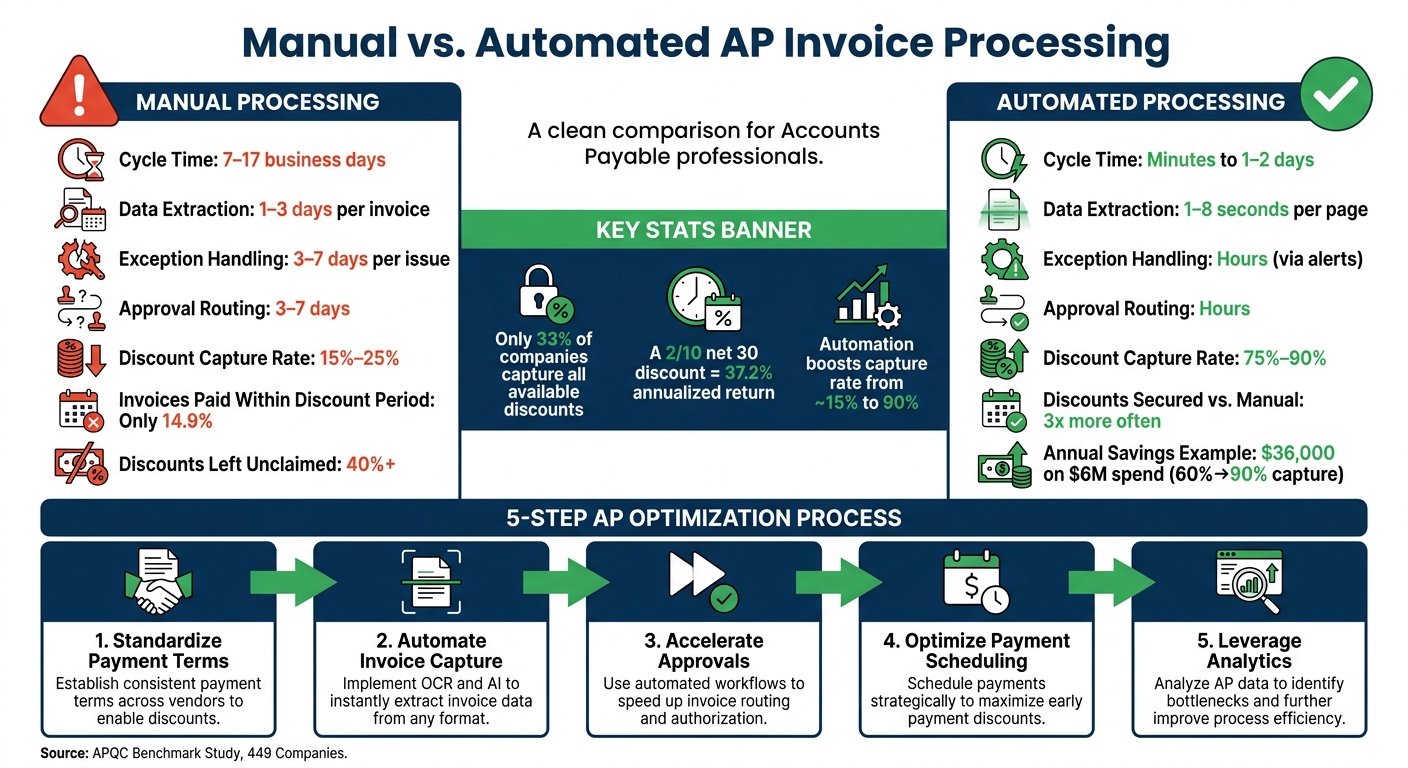
Early payment discounts can save businesses significant money, but many AP teams miss out due to slow processing. This article covers five strategies to help AP teams pay invoices faster and secure discounts like “2/10 net 30”, which offers a 2% discount for payments made within 10 days. Here’s how to improve efficiency:
- Standardize Payment Terms: Align vendor terms to avoid confusion and simplify workflows.
- Automate Invoice Processing: Use AI tools to speed up data entry and matching, reducing delays.
- Accelerate Approvals: Implement automated workflows to cut approval times from days to hours.
- Optimize Payment Scheduling: Prioritize payments based on discount deadlines, not fixed cycles.
- Leverage Analytics: Track missed discounts and improve processes with data-driven insights.
Key Fact: Only 33% of companies secure all available discounts, but automation can boost this rate to 90%. Investing in tools like AP Express ensures faster processing, better cash flow management, and significant cost savings.
1. Standardize Early Payment Terms and Policies
Setting consistent payment terms is key to capturing early payment discounts. When terms vary across suppliers, invoice formats, or accounts payable (AP) staff, it creates confusion and missed opportunities. By unifying payment terms across master service agreements (MSAs), purchase orders, and your vendor master file, you eliminate ambiguity, simplify processes for AP staff, and reduce disputes.
Standardized early payment terms typically include three elements: a discount percentage (e.g., 1% or 2%), a shortened payment window (e.g., 10 or 15 days), and a final payment deadline (e.g., net 30 or net 45). This uniformity is critical for streamlining invoice matching, automating workflows, and leveraging advanced analytics, which will be discussed later.
If a strict 10-day payment window feels too rigid, consider a tiered discount structure. For example, offer 2% for payments within 10 days and 1% for payments within 15 days. Aligning these discount windows with regular payment cycles can also help minimize the need for ad-hoc payment runs.
This standardization forms the foundation for the more efficient processes outlined in the next strategies.
Impact on Early Payment Discount Capture and Invoice Processing Time
Standardized terms make it easier to automate invoice flagging and enable straight-through processing. This reduces manual errors and avoids delays that could result in missed discounts. According to an APQC benchmark study of 449 companies, only 14.9% of invoices are paid within the discount period on average. However, organizations that both standardize and automate their processes capture early payment discounts three times more frequently than those relying on manual methods.
When invoice terms align with the purchase order and ERP system settings, invoices can flow through the system without hitting exception queues. These queues often delay processing by 3–7 days, which can eat up a significant portion of a 10-day discount window. Removing this bottleneck can be the difference between securing a discount or losing it entirely.
Improvement in Cash Flow Management
Predictable payment terms allow treasury and finance teams to plan more effectively. Instead of making last-minute payment decisions, they can incorporate a “discount capture” line item into weekly cash flow forecasts. However, before committing to a standardized early payment policy, ensure your business has at least 30 days of operating expenses in cash to maintain liquidity.
“The decision to take or skip these discounts can mean the difference between earning a 36.5% annualized return and losing that value entirely.” – Juwon Lee, Former CFO
Ease of Integration with Oracle ERP Systems
Standardized payment terms can be directly configured into Oracle ERP systems such as Oracle EBS, ERP Cloud, and JD Edwards. These systems automatically calculate discount deadlines based on invoice dates and schedule payments at the optimal time. Tools like AP Express take this further by using AI to extract payment terms as soon as an invoice enters the system. This makes discount opportunities visible to Oracle immediately, eliminating the need for manual review and enabling the automated workflows discussed in upcoming strategies.
2. Streamline Invoice Capture and Matching in Oracle ERP
Once payment terms are standardized, the next step is to speed up invoice capture. Even with clear terms like 2/10 net 30, those discounts are meaningless if invoices take weeks to process. The real obstacle lies in capturing, entering, and matching invoices – not in treasury strategy. By automating invoice capture, you can ensure those savings aren’t lost due to processing delays.
“The gap between ‘we could pay early’ and ‘we actually do pay early’ is an invoice processing gap, not a treasury strategy gap.” – David Harding, Author
Impact on Early Payment Discount Capture
Early payment discounts hinge on timing, which starts the moment an invoice is issued – not when your accounts payable (AP) team sees it. In manual workflows, delays in the mailroom or inbox can eat up 3–5 days of a 10-day discount window before anyone even begins processing. Automating invoice capture eliminates this lag by immediately posting invoices to Oracle ERP upon receipt. This gives your team the maximum time to review, match, and approve invoices before the discount deadline.
Manual workflows often lead to missed discounts, but automation solves this by flagging discount-eligible invoices at the intake stage. These invoices are prioritized over standard-term invoices, ensuring deadlines are met.
Reduction in Invoice Processing Time
Manual workflows are notoriously slow. Even a clean invoice with no exceptions can take 7 to 17 business days to process – far beyond the 10-day discount window. By contrast, AI-powered data extraction can pull header data, line items, and payment terms in just 1–8 seconds per page, compared to the 1–3 days manual entry typically requires.
Three-way matching, which involves cross-checking the invoice against the purchase order and goods receipt note, is another area where manual processes frequently stall. Price or quantity discrepancies can delay processing by 3–7 business days. Automated systems, however, resolve these discrepancies instantly or escalate them without pausing the workflow.
| Processing Stage | Manual Timeline | Automated Process Duration |
|---|---|---|
| Receipt & Intake | 2–5 business days | seconds |
| Data Entry & Matching | 1–3 business days | seconds |
| Exception Handling | 3–7 business days | Minutes (via alerts) |
| Approval Routing | 3–7 business days | Automatic |
| Total Cycle Time | 7–17 business days | Hours to 1–2 days |
Improvement in Cash Flow Management
Automating invoice capture not only speeds up processing but also improves cash flow visibility. When invoices pile up unprocessed, it’s impossible to accurately forecast liabilities, which can disrupt financial planning. With automation, treasury teams gain real-time insights into upcoming payment obligations, enabling better cash flow management.
For example, a business with $600 million in annual spend could see a significant difference in savings depending on its early payment discount capture rate. Improving from a 60% to a 90% capture rate on only 10% of annual spend could save $360,000 per year. This illustrates how removing processing bottlenecks directly impacts the bottom line.
Ease of Integration with Oracle ERP Systems
Automation doesn’t just reduce processing times; it also integrates seamlessly with Oracle ERP systems, simplifying payment execution. Tools like AP Express connect directly with Oracle EBS, ERP Cloud, and JD Edwards to automate invoice capture and three-way matching. AI-powered digitization extracts invoice data at intake and posts approved invoices directly to the general ledger, eliminating manual data entry and rekeying delays. Additionally, discount-eligible invoices are automatically flagged and prioritized based on their financial value, ensuring that your AP team focuses on the most impactful opportunities.
3. Accelerate Approvals with Automated Workflows
Efficient invoice capture can only go so far if approvals take too long. And unfortunately, those delays are often the reason early payment discounts slip away unnoticed.
“Slow approvals are the number one reason discount windows expire.” – AI Accountant
Impact on Early Payment Discount Capture
Manual approval processes are the biggest roadblock in the invoice lifecycle. The time spent routing invoices manually often eats up the entire discount window after capture and matching. Automated workflows solve this problem by instantly sending invoices to the right approvers as soon as they’re validated. No emails to forward, no follow-ups required.
Parallel routing takes this a step further. Instead of waiting for one approver to finish before moving to the next, multiple stakeholders can review the invoice at the same time. This cuts down the cycle time to match the pace of the slowest reviewer, rather than adding up everyone’s time. This approach, combined with deadline-based escalation (which reassigns stalled invoices within 24–48 hours), ensures that discount windows stay open even when key team members are unavailable.
Here’s a telling statistic: across 449 companies, the median rate of invoices paid within the discount period was just 14.9%. But organizations that automate their invoice processing capture early payment discounts three times more often than those using manual methods.
Reduction in Invoice Processing Time
Automated workflows eliminate the need for constant follow-ups and re-routing, slashing processing times from days to just minutes. Features like auto-approval rules speed things up even more. For example, recurring invoices that match purchase orders and goods receipts within set tolerances can bypass manual review entirely. This allows AP teams to focus on exceptions and high-value invoices instead of routine tasks.
By combining parallel routing with escalation, approval cycles shrink from days to hours, pushing discount capture rates from around 60% to an impressive 90%.
Improvement in Cash Flow Management
Faster approvals also mean better cash flow control. When approval timelines are unpredictable, it’s tough for treasury teams to plan payments effectively. This uncertainty makes it harder to decide whether capturing a discount is worth it based on current cash availability and the cost of capital.
With automated workflows, finance teams gain real-time visibility into the status of every invoice in the approval process. This transparency makes it easier to plan payment schedules, letting you confidently take discounts when cash is available or defer payments to net terms when needed.
Ease of Integration with Oracle ERP Systems
Automated approvals don’t just speed things up – they also ensure that no discount opportunity slips through the cracks. Tools like AP Express integrate seamlessly with Oracle EBS, ERP Cloud, and JD Edwards, using live ERP data to enforce business rules. Approval workflows can be configured based on cost center ownership, PO references, or dollar thresholds tied to your Oracle system, ensuring they align with your organization’s structure without requiring manual adjustments. Once approved, invoices are posted directly to the general ledger, eliminating rekeying and delays. This streamlined process sets the stage for smarter payment scheduling and funding decisions in the next step of the strategy.
4. Optimize Payment Scheduling and Funding Decisions
Even with quick approvals, traditional fixed payment cycles can cause missed opportunities for early payment discounts. Moving from static schedules to deadline-driven payment planning can make a big difference.
Impact on Early Payment Discount Capture
Most accounts payable (AP) teams stick to fixed payment runs, often every two weeks. But here’s the issue: a common discount like 2/10 net 30 gives you just 10 days to pay and claim the discount. A bi-weekly schedule might not align with that window. Switching to a deadline-based approach – where invoices are prioritized based on their discount deadlines – ensures these opportunities aren’t missed.
It’s important to note that the discount clock starts ticking from the invoice date. Manual processing can eat up 3–5 days of that 10-day window before the invoice is even ready for payment. This is why speeding up earlier stages like invoice capture, matching, and approval is crucial. Without this shift, manual processes leave over 40% of available discounts unclaimed, primarily because payment timing isn’t aligned with discount deadlines. Adopting deadline-driven scheduling complements improvements in earlier AP workflows.
Improvement in Cash Flow Management
Grabbing every discount isn’t always the best move. If cash reserves are tight, paying early could cause more harm than good. In fact, 82% of small businesses fail due to poor cash flow management. The smarter approach? Only take discounts when your cash reserves cover at least 30 days of operating expenses, and when the annualized return from the discount is at least 5 percentage points higher than your cost of capital. Otherwise, stick to paying on the net due date.
| Cash Position | Discount Return vs. Cost of Capital | Decision |
|---|---|---|
| Above 30 days OpEx | Exceeds by 5%+ | Take the discount |
| Above 30 days OpEx | Below threshold | Pay on net due date |
| Below 30 days OpEx | Any | Preserve cash |
To make better decisions, integrate early payment evaluations into a rolling 13-week cash flow forecast. This approach helps treasury teams see the bigger picture, making it easier to determine when to pay early and when to hold back.
Ease of Integration with Oracle ERP Systems
Automation is a game-changer here. By syncing payment schedules with live ERP data, this strategy builds on earlier automation improvements. Tools like AP Express seamlessly connect with Oracle EBS, ERP Cloud, and JD Edwards, automating funding decisions in real time. This system can flag invoices with active discount terms, calculate their annualized return, and compare them against live cash positions – all without manual input.
“If your dashboard cannot answer ‘which invoices should we pay early this week and what is the return?’ in under 30 seconds, it needs work.” – Rohan Sinha, Fintech Leader, AI Accountant
5. Use Analytics to Track and Improve Discount Capture
Analytics can take your accounts payable (AP) process to the next level by identifying missed opportunities and driving better results. It shifts your approach from simply reacting to being proactive, especially when it comes to capturing early payment discounts.
Impact on Early Payment Discount Capture
Start by measuring your discount capture rate. Right now, only 33% of organizations manage to secure all available discounts, and the median invoice capture rate stands at 14.9%. That means there’s a lot of untapped potential – and this is exactly where analytics can make a difference.
A great way to start is with a 90-day lookback audit. Review the last three months of vendor invoices, compare the discounts offered with those actually captured, and calculate the dollar value of missed savings. From there, analytics can help you segment your vendors by spend and discount terms, allowing you to focus on the opportunities that will deliver the highest returns.
Reduction in Invoice Processing Time
Analytics can pinpoint where delays happen in your invoice cycle. Break down your process into key stages – intake, data entry, exception handling, and approval routing – and measure how long each one takes. For example, if exception handling alone is dragging on for 3–7 business days, you’ve found a bottleneck.
Tracking your exception rate – the percentage of invoices that require manual intervention – can also reveal where inefficiencies lie. Once you have this data, you can set improvement targets and monitor progress on a weekly basis.
Improvement in Cash Flow Management
Incorporating a discount capture line into your 13-week cash flow forecast can help treasury teams plan for early payments in a more systematic way, avoiding last-minute scrambles.
You can also establish a hurdle rate, which is the minimum annualized return needed to justify taking a discount. Typically, this rate should exceed your company’s weighted average cost of capital (WACC) by 200–300 basis points. Discounts that fall below this threshold can be deprioritized, allowing your team to focus on the opportunities that have the most impact.
| Decision Factor | Action Based on Analytics |
|---|---|
| Cash below 30 days of operating expenses | Preserve cash regardless of discount |
| Discount ROI < WACC + 3% | Skip the discount |
| Strategic or sole-source vendor | Prioritize to strengthen the relationship |
This approach ensures that your cash flow decisions are both data-driven and aligned with your broader financial goals.
Ease of Integration with Oracle ERP Systems
Tools like AP Express make it even easier to track and improve discount capture by seamlessly integrating with Oracle EBS, ERP Cloud, and JD Edwards. This eliminates the need for manual data exports or custom queries.
With built-in reporting dashboards, AP teams can track expiring discount windows and monitor invoice statuses, while executives get a clear view of ROI and total savings. This layered visibility ensures that everyone – from AP staff to leadership – has access to the information they need.
As Rohan Sinha, Fintech Leader and AI Accountant, puts it: “If your dashboard cannot answer ‘which invoices should we pay early this week and what is the return?’ in under 30 seconds, it needs work”.
Comparison Table
Use the tables below to quickly compare discount terms and processing performance.
Overview of Early Payment Discount Terms
| Discount Term | Discount % | Days to Pay | Net Due Days | Annualized Return |
|---|---|---|---|---|
| 1/10 net 30 | 1% | 10 days | 30 days | 18.4% |
| 2/10 net 30 | 2% | 10 days | 30 days | 37.2% |
| 2/15 net 45 | 2% | 15 days | 45 days | 24.8% |
| 3/10 net 30 | 3% | 10 days | 30 days | 56.4% |
| 1/10 net 20 | 1% | 10 days | 20 days | 36.9% |
| 2/10 net 60 | 2% | 10 days | 60 days | 14.9% |
Both 2/10 net 30 and 2/10 net 60 provide a 2% discount, but the annualized return drops significantly from 37.2% to 14.9% due to the longer payment period.
“Forgoing this discount is equivalent to paying a 36.5% annualized interest rate on the money you hold for those extra 20 days.” – Juwon Lee, Former CFO
While favorable discount terms are important, the speed of invoice processing plays a critical role in capturing these savings.
Manual vs. Automated Invoice Processing
The table below highlights the differences between manual and automated processing, showcasing why automation is a game-changer.
| Feature | Manual Processing | Automated Processing |
|---|---|---|
| Cycle Time | 7–17 business days | Minutes–Hours |
| Extraction Time | 1–3 days (manual entry) | Seconds |
| Discount Capture Rate | 15%–25% | 75%–90% |
| Accuracy | Higher risk of errors | High accuracy |
| Exception Handling | 3–7 days per investigation | Pre-validated at intake |
Manual processing, which averages around 12 business days, often misses the standard 10-day early payment discount window. In contrast, automated systems can process invoices in minutes, achieving discount capture rates as high as 90%.
Platforms like AP Express streamline this process by integrating directly with Oracle ERP systems. They automate key tasks like intake, data extraction, and approval routing, making it easier to capture discounts and improve cash flow management.
Conclusion
The five strategies discussed – standardizing payment terms, improving invoice capture, speeding up approvals, fine-tuning payment scheduling, and leveraging analytics – are most effective when used together. Each addresses a specific bottleneck in the AP cycle, helping to bridge the gap between slow manual workflows and the standard 10-day discount window. Together, they create a smoother process that ensures every discount opportunity is seized.
Consider this: a standard 2/10 net 30 discount translates to an annualized return of about 37.2%. Yet, only 14.9% of invoices are typically paid within the discount period. That difference represents significant savings lost – not due to cash flow constraints, but because of inefficiencies in processing.
For Oracle ERP users, solving this issue means adopting tools that seamlessly integrate with existing systems and enable smarter decisions throughout the invoice lifecycle. AP Express offers such a solution, connecting with Oracle EBS, ERP Cloud, and JD Edwards to automate key tasks like invoice intake, matching, approvals, and payment scheduling. Powered by AI, AP Express processes invoices in seconds, using flexible workflows to keep approvals on track. By automating these processes, organizations can consistently capture early payment discounts – teams using automated systems secure these discounts 3x more often than those relying on manual methods.
FAQs
How do I calculate the ROI of an early payment discount?
To figure out the ROI for an early payment discount, you can use this formula: Annualized Return = (Discount % / (100% – Discount %)) × (365 / (Net Days – Discount Days)).
Here’s an example to break it down: Imagine you’re offered a 2% discount for paying within 10 days on terms of net 30. That means you’re paying 20 days earlier than usual. Plugging into the formula: (2% / 98%) × (365 / 20) ≈ 37% annualized return. This shows a significant short-term return, especially if your cost of capital is lower than this rate.
When should we skip a discount to protect cash flow?
If paying early for a discount puts a strain on your cash flow, it’s better to skip it. This is particularly true if the savings from the discount are smaller than your borrowing costs or if early payment interferes with your cash flow projections or Days Payable Outstanding (DPO) goals. In such situations, keeping your financial stability intact should take priority over chasing discounts.
What Oracle ERP setup helps us prioritize discount deadlines?
Configuring supplier selection criteria and early payment discount campaigns in Oracle AI Apps for ERP helps businesses stay on top of discount deadlines. By setting up these criteria, companies can pinpoint the right suppliers and automate the handling of discount offers. This process ensures deadlines are met without hassle, making operations smoother and more efficient.
Related Articles

9 AP KPIs for Data-Driven Decisions
June 16, 2026 Want to improve your accounts payable (AP) process? Start with these 9...
The Best Out-of-the-Box AP Automation Solutions
April 29, 2026 In recent conversations with several prospects, we learned that they are implementing...